Strengthening the Digital Experience at the Amon Carter Museum Through Data-Driven Insights

overview
Our team partnered with the Amon Carter Museum of American Art to help them deepen their understanding of digital performance across their website and social channels. After transitioning to GA4, the museum felt confident pulling basic metrics, but struggled to translate data into strategic guidance. They wanted to know: “What is actually working, what isn’t, and where should we focus our digital efforts next?”
With this question in mind, we conducted a comprehensive audit on their web performance, SEO, and Instagram, delivered actionable recommendations that resolve technical performance barriers, strengthen organic search visibility, and expand engagement with the critical 18–34 demographic.
my contributions
🔍 Conducted Data-Driven SEO & Performance Analysis
Analyzed SEMRush metrics, PageSpeed Insights, and technical diagnostics to uncover indexing issues, performance gaps, and visibility constraints affecting content discoverability.
💡 Identified Key Insights & Actionable Recommendations
Synthesized cross-channel findings—SEO, web performance, social engagement, and dashboard analytics—into clear problem statements and prioritized recommendations aligned with museum goals.
📊 Designed an Improved Analytics Dashboard
Created mockups of their Looker Studio dashboard to enhance data visibility, filter accuracy, and reporting clarity, enabling the museum to make faster, insight-driven decisions.
🎨 Led Presentation Storytelling & Final Deliverable Design
Designed the final presentation slide deck, shaping the narrative, visual structure, and storytelling flow used for the team’s final presentation at Nasdaq.
year
2025
duration
6 weeks, Oct 2025 - Dec 2025
tools
SEMRush, GA4, Google Search Console, Looker Studio, PageSpeed Insights, Meltwater, Excel, & Figma
category
Digital Analytics Client Project
client
Amon Carter Museum of American Art
my role
Digital Analyst UX Consultant UX Designer
team
Gloria Yang (Me) Kevin Zhang James Huang
• THE BACKGROUND
Before Diving Into Analysis: What's Cater's Mission & Audience?
Before analyzing data, we grounded ourselves in the Carter’s mission and audience. The Amon Carter Museum of American Art in Fort Worth, Texas, is dedicated to the celebration and advancement of American creativity. Established in 1961, the museum now houses an expansive collection spanning from the 18th century to contemporary works, with a mission to foster accessibility and engagement for all.
Their website functions as a gateway to collection archives, a hub for exhibitions, events, and educational resources, and a storytelling platform for expanding reach beyond Texas for visitors, students, researchers, teachers, and art enthusiasts.
Understanding these became the foundation for how we evaluated every metric and recommendation.

Gif of Current Amon Carter Museum Website
• SNEAK PEEK OF OUR FINAL STRATEGY
Our Final Strategy at a Glance
Before diving into the full audit and insights, here’s the strategy we ultimately delivered to the Amon Carter, a unified roadmap across SEO, Web Performance, and Social that strengthens visibility, improves data accuracy, and drives deeper engagement.
SEO Strategy
Strengthen search visibility by consolidating duplicate domains into one authoritative version.
Improve search relevance through meaningful anchor text and high-quality backlinks.
Boost performance with faster pages and cleaner code.
Grow non-branded discovery through evergreen content and structured data.
Web Performance Fixes
Fix tracking and attribution issues so marketing channels are accurately measured.
Remove bot-heavy traffic and clean geographic noise for reliable reporting.
Improve UX on high-intent pages to increase conversions.
Enhance site search clarity with better indexing, metadata, and relevance tuning.
Instagram Strategy
Shift from static posts to human-centered storytelling moments that highlights curators, artists, educators, and community voices.
Convert "flyer content" to 2–5 frames carousels for save-worthy.
Build a reel-based "museum stories" content library like BTS moments, Q&A series, artist talks, to drive reach, saves, and shares.
• OUR PROCESS
What We Did to Help Our Client?
To transform scattered analytics into a strategic framework the museum could act on, we followed a structured process, starting with alignment, then diving deep into SEO, website performance, social insights, and dashboards, before synthesizing everything into a unified digital strategy.
Let me walk you through our process ↓
• KICK-OFF MEETING & ALIGNMENT
We Started with Laying the Groundwork: Understanding Needs & Securing Data
Our work began with a collaborative kick-off meeting with the museum’s digital team, Michelle & Clara. We discussed their challenges, clarified their goals, and aligned on success metrics. Most importantly, we defined what strategic analytics meant in the context of their museum operations, which is not just reporting number, but understanding what those numbers should influence.
With that alignment, we secured access to GA4, Google Search Console, Looker Studio, and Meltwater, preparing the full data ecosystem needed for a comprehensive digital audit.
• SEO ANALYSIS
The Hidden SEO Pathways:
How Users Search for the Carter and Where the Journey Breaks
We began our audit with SEO because discoverability is the first gateway to every digital experience. If users can’t find the museum, improvements in content, UX, and social strategy cannot reach their full potential. During our kickoff, the Carter emphasized a desire to grow non-branded discovery and attract new audiences, making search visibility a natural starting point.
SEO also provides the structural clues about what might be holding the ecosystem back: domain health, content relevance, and technical barriers. Once we uncovered issues such as duplicate domains and diluted authority, it became clear that strengthening this foundation was essential before moving deeper into behavioral insights
Finding 1
Duplicate Domains Diluting Authority & Causing Tracking Errors
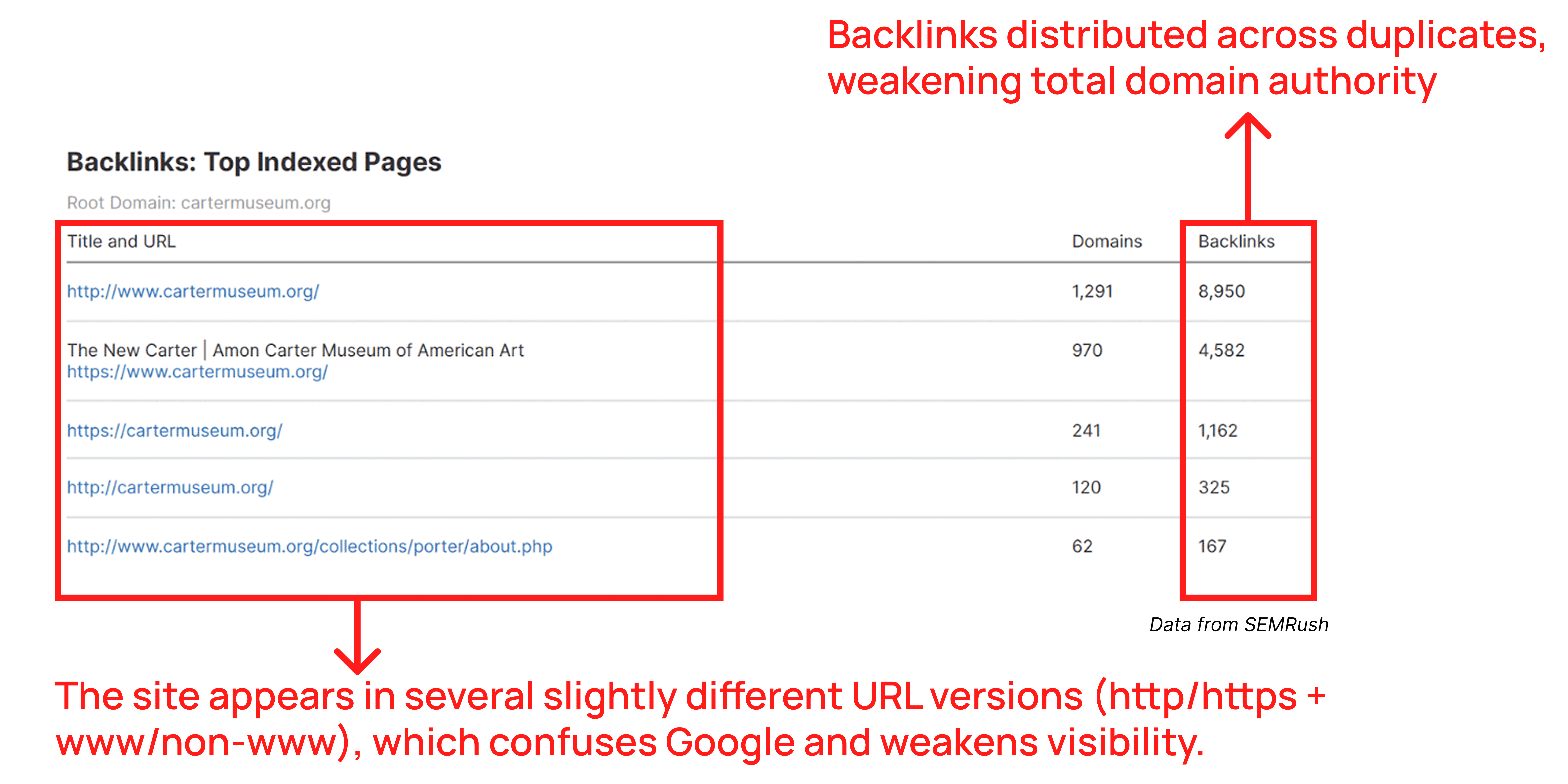
According to the data from SEMRush, Google is currently indexing four versions of the domain (http/https + www/non-www). Because of this, the site’s authority is being split across four different URLs instead of one.
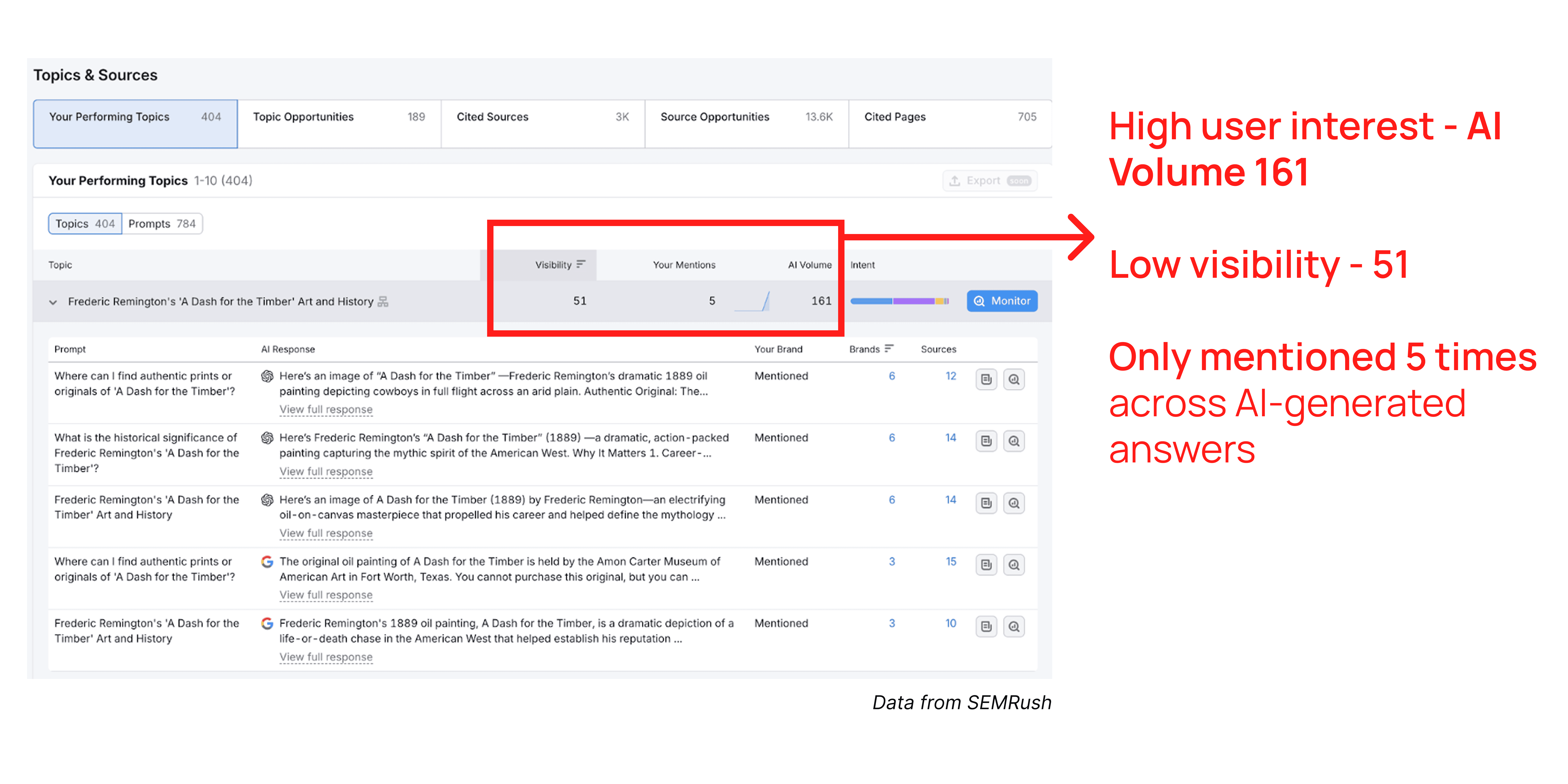
Even with strong user interest (AI Volume 161), Carter content is rarely surfaced. The museum is only mentioned 5 times across AI-generated answers, indicating low visibility (Score 51) and weakened authority signals, likely influenced by duplicate domains.
This makes it harder for Google to understand which version to rank, weakens overall search visibility, and weakens how AI search systems understand and reference the museum.
Recommendation 1
HIGH IMPACT
To address this, we recommend consolidating all domain variations into one canonical version. This immediately centralizes authority, prevents split ranking signals, and increases the likelihood that Carter content is surfaced in both Google and AI search results.
Finding 2
Strong Branded Visibility, Limited Non-Branded Discoverability
The museum performs extremely well for branded keywords, confirming strong brand recognition and loyalty among users who already know the Carter. However, the site struggles to rank for broader, non-branded terms.
Most non-branded keywords rank between positions 21–100, and only 863 keywords trigger SERP features. This means that users searching for topics like Western art, American artists, Fort Worth things to do, museum exhibits, or art history information are far less likely to discover the Carter organically.
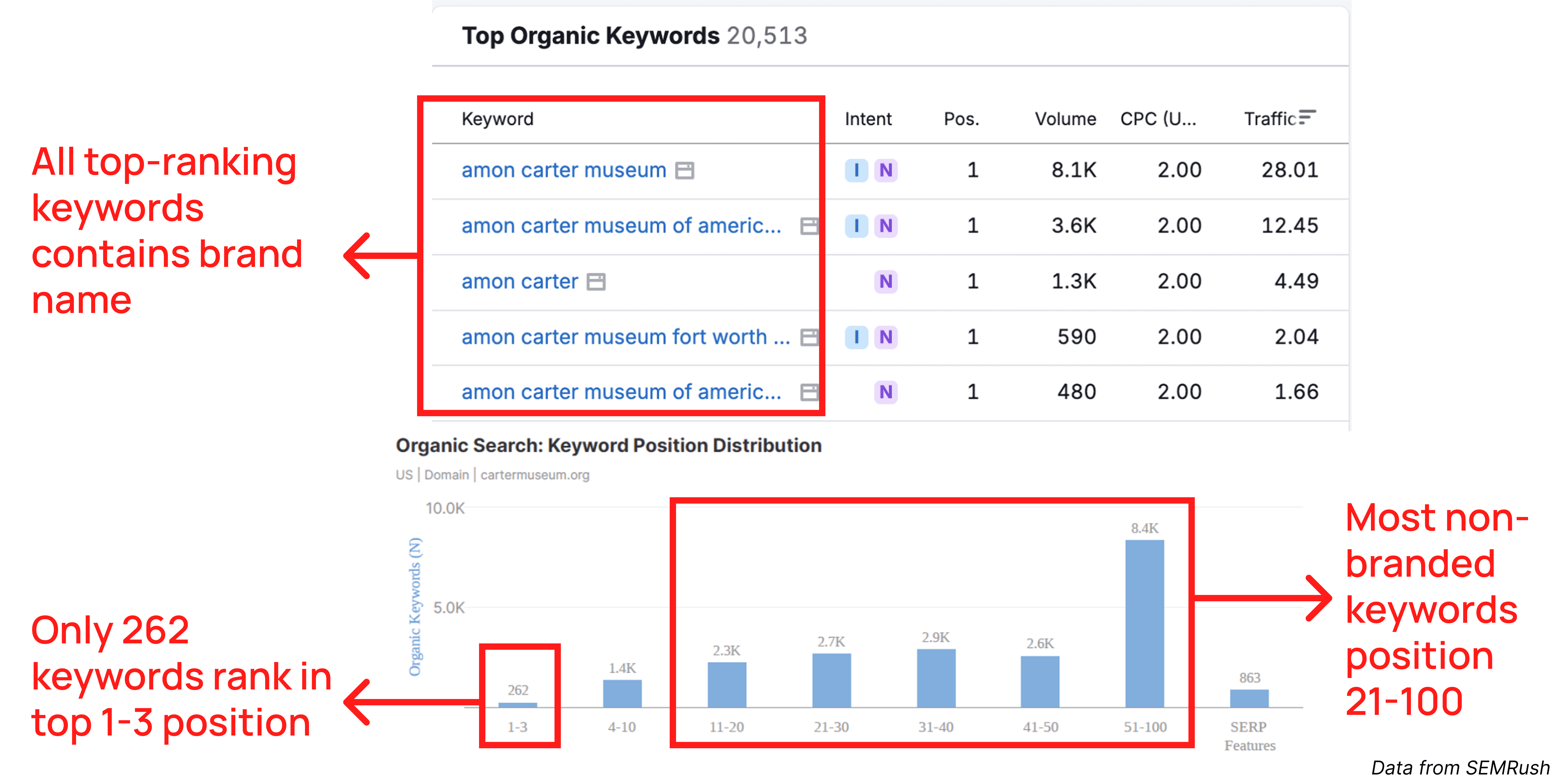
The Carter is highly visible to people who already know it, but nearly invisible to people who don’t know it, limiting opportunities to grow new audiences.
Recommendation 2
LONG-TERM
To address this, we recommend expanding reach beyond existing audiences, the museum should strengthen non-branded visibility by building richer evergreen content and optimizing key on-page SEO elements.
Expanding informational resources like exhibit explainers, artist deep-dives, educational materials, and “Plan Your Visit” content to better match what people search for.
Refining metadata (titles, descriptions, H1/H2s) to target long-tail queries related to art history, artists, exhibitions, and Fort Worth travel.
Strengthening internal linking from high-authority pages (e.g., exhibitions, collection highlights) to improve ranking potential for mid-ranking content.
Implementing structured data & FAQs to help pages surface in SERP features like featured snippets, rich cards, and AI overviews.
Building this foundation will meaningfully increase discoverability among new audiences and improve the museum’s visibility across AI-driven search surfaces.
Finding 3
Backlinks are Missing Anchor Text
A significant portion of the Carter’s backlink profile lacks the descriptive context that helps search engines understand why other sites are referencing the museum.
78% of backlinks use empty anchor text, meaning the clickable link contains no words at all. Many of these come from artsandculturetx.com and glasstire.com, two of the Carter’s most frequent referrers.
Additionally, 73% of all backlinks are image-type links. While visually fine for users, image links provide little to no semantic meaning for Google. Without descriptive anchor text, search engines can’t associate these backlinks with relevant topics such as exhibitions, artists, or educational content.
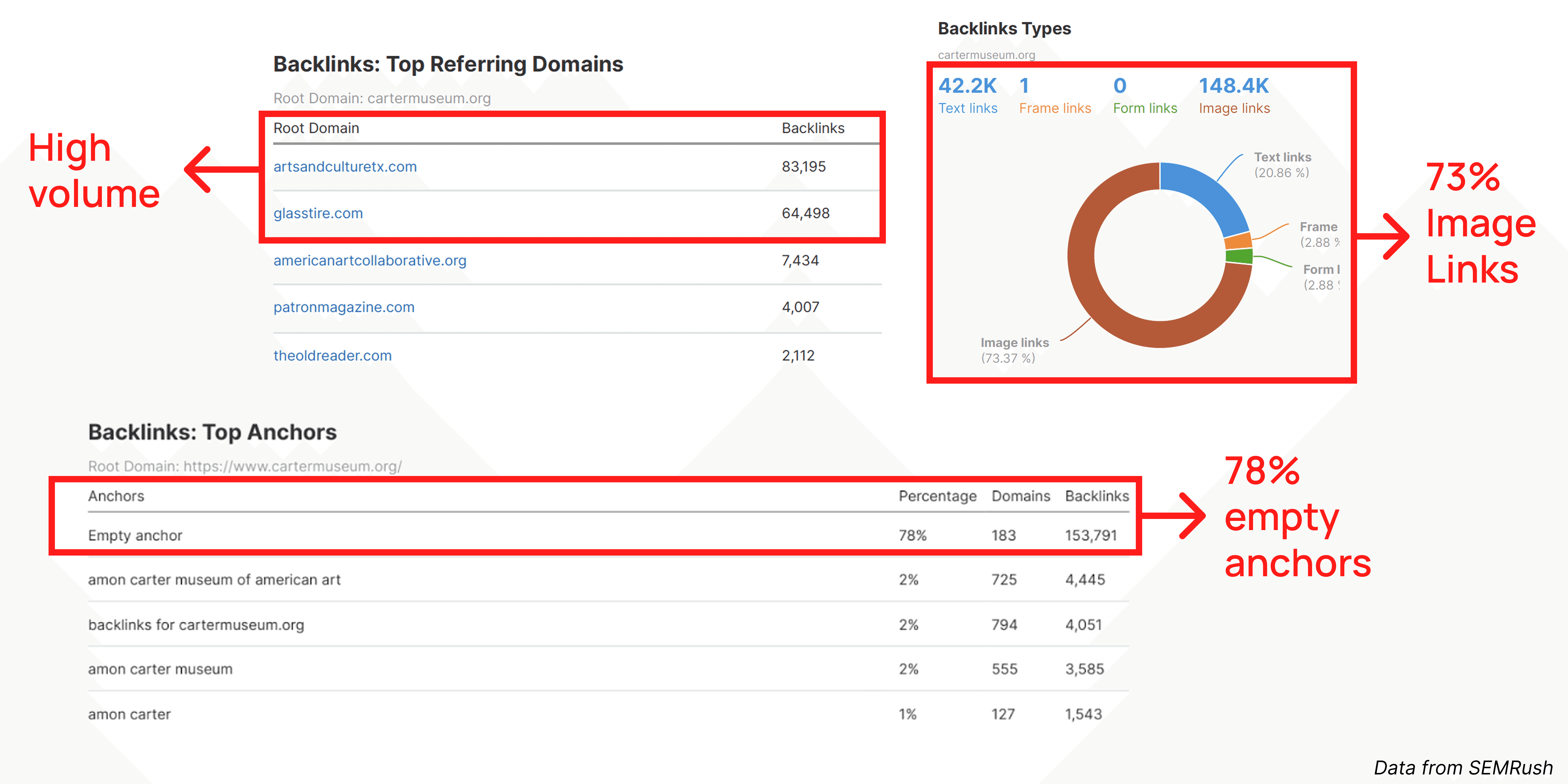
This lack of context weakens the museum’s non-branded authority, making it harder for the Carter to rank for searches beyond its name.
Recommendation 3
HIGH IMPACT
To address this, we recommend working with top referring domains to replace empty or image-only anchors with meaningful, descriptive text. Encourage partners to use anchors that reference exhibit titles, artist names, Fort Worth art terms, or key thematic phrases. This will give Google clearer semantic signals, strengthen the museum’s topical authority beyond branded terms, and improve visibility for non-branded searches such as exhibits, events, and educational resources.
Finding 4
Slow Page Speed is Reducing Engagement across Both Desktop & Mobile
PageSpeed Insights revealed performance issues on both platforms: Desktop performance score 47, and Mobile performance score 36.
Large, uncompressed images, unused JavaScript, render-blocking scripts, and mismatched image dimensions significantly slow down load time. These issues directly impact Largest Contentful Paint (LCP), Total Blocking Time (TBT), and overall page load speed and user experience.
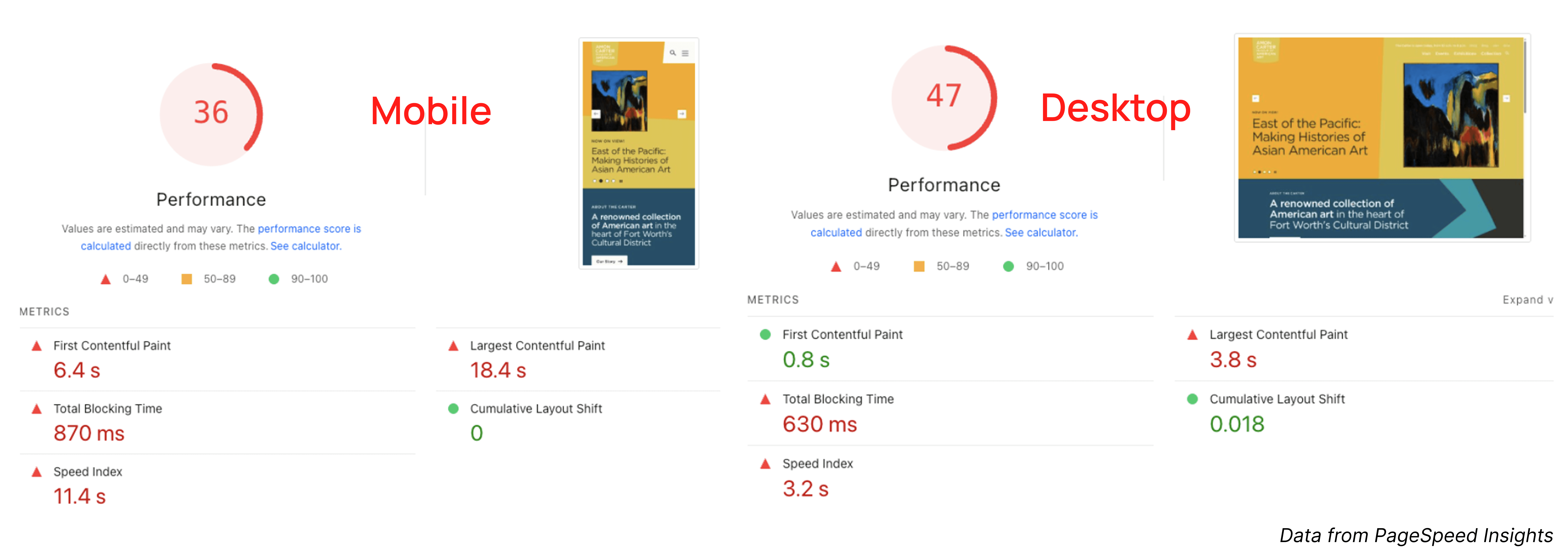
Slow performance discourages deeper exploration, reduces session duration, and limits how effectively users engage with important content such as exhibitions, education pages, and event listings.
Recommendation 4
QUICK WIN
To address this, we recommend reducing large image file sizes, converting assets to next-gen formats (WebP/AVIF), and ensuring all images match their rendered display dimensions to prevent layout shifts. Remove unused JavaScript and defer non-critical scripts to eliminate render-blocking behavior. These improvements will meaningfully enhance LCP, TBT, and overall page load speed across both desktop and mobile.
• WEB PERFORMANCE ANALYSIS
Web Performance Analysis:
What Happens After Users Arrive
After diagnosing how users find the Carter online, our next question became: “What happens once visitors actually arrive on the site?” This shift was guided by the Carter’s goal to improve engagement and event attendance. SEO told us who was coming and from where, but Web Performance revealed what they do when they get there.
Finding 1
Unusually High “Direct” Traffic That Almost Matched Organic Search
GA4 shows that 52K new users are labeled as “Direct” which is almost equal to 59K Organic Search. This is not typical for a museum website and suggests that a large portion of marketing traffic is being misattributed. This misattribution makes it difficult for the Carter to understand which channels are driving value and where to invest.
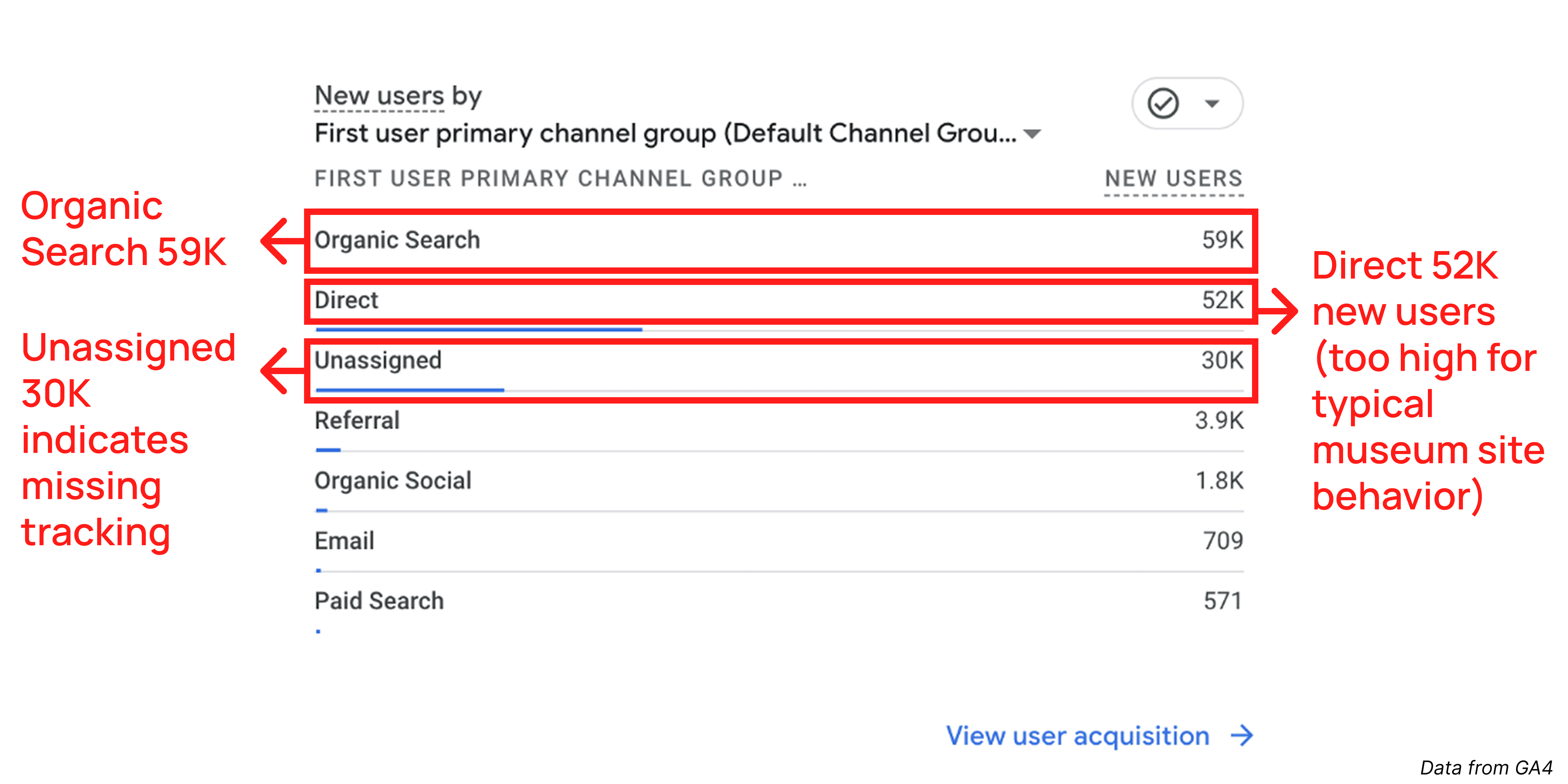
This pattern signals that tracking systems are breaking down and must be corrected to improve attribution accuracy.
Recommendation 1
QUICK WIN
To address this, we recommend repairing redirect chains and enforcing consistent UTM usage across every marketing and partner touchpoint.
Use consistent and unique UTMs on all newsletters, social posts, paid ads, partner sites, and QR codes
Audit redirect paths to ensure tracking parameters survive redirects
Create a museum-wide UTM naming standard with templates
Test all landing pages to confirm UTMs persist
Enable auto-tagging in applicable paid platforms
Once attribution is corrected, the museum can clearly see which campaigns genuinely drive new users which is currently impossible with inaccurate “Direct” reporting.
Finding 2
Bot activity from overseas cities artificially inflating sessions
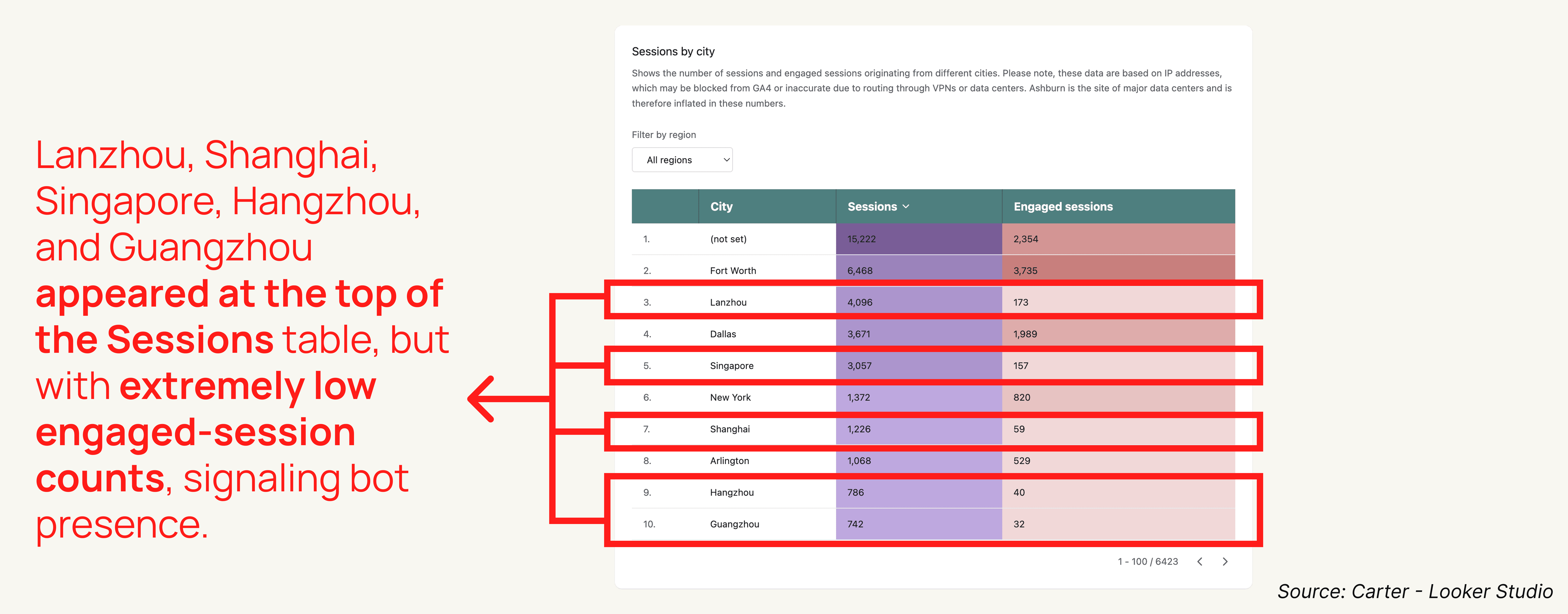
From the Looker Studio data here, we can see a large share of traffic is coming from cities such as Lanzhou, Shanghai, Hangzhou, Guangzhou, and Singapore, all showing extremely low engagement (4–5%). This is not consistent with real audience behavior and strongly suggests bot or spam activity. These sessions have very low engagement time, high bounce behavior, and minimal interactions.
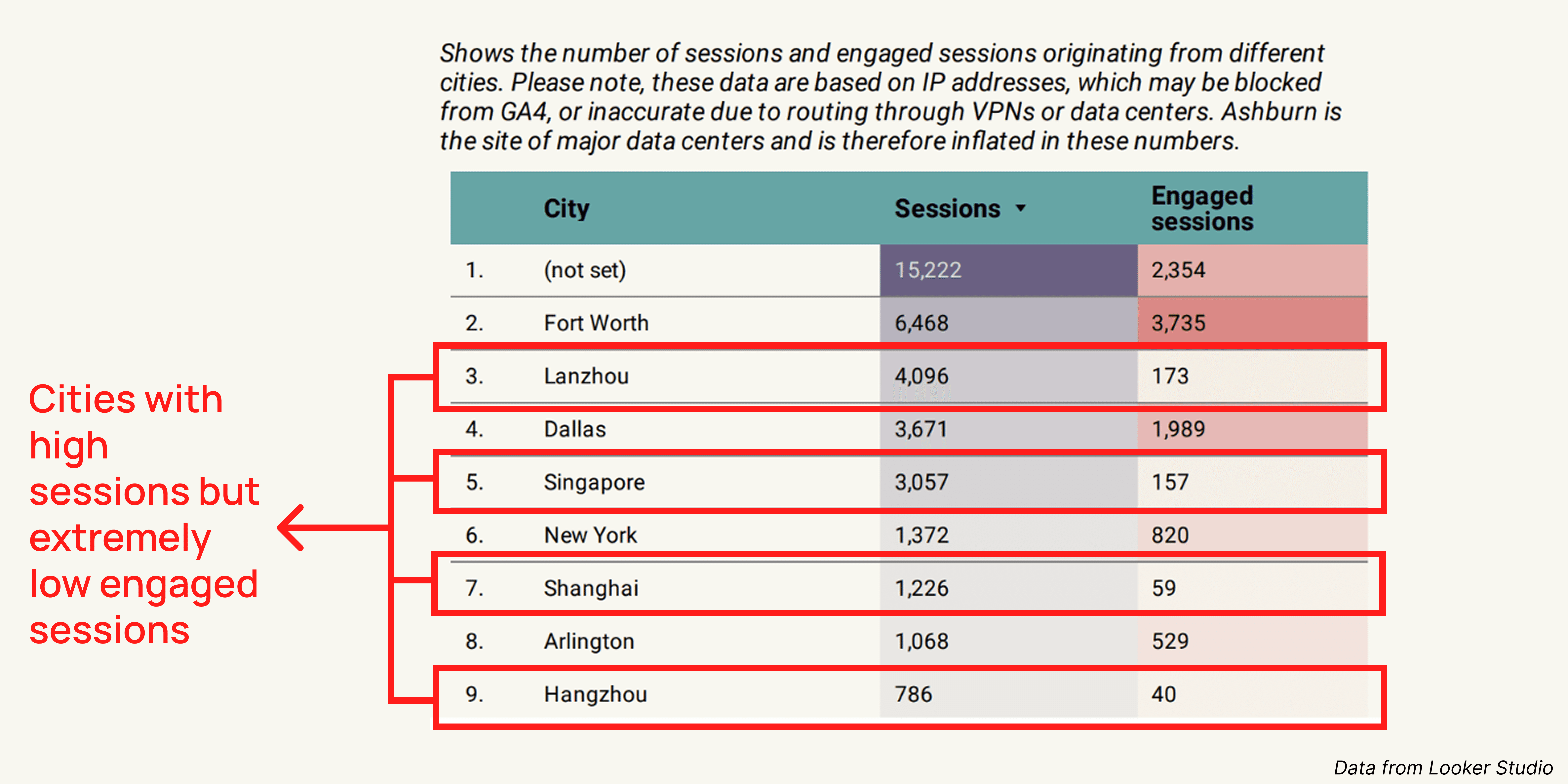
This artificially drives metrics down, especially bounce rate and average session duration, making it difficult for the museum to understand how real visitors interact with content.
Recommendation 2
LONG-TERM
To address this, we recommend enabling GA4’s enhanced bot filtering options and applying geographic exclusion filters for cities with repeated bot-like activity. This will remove distorted sessions from reporting, restore accurate engagement metrics, prevent inflated traffic from overshadowing real user behavior, allow the museum to confidently evaluate content performance and UX effectiveness. Ultimately supporting museum strategic decision-making, campaign optimization, and long-term digital growth.
Finding 3
20% of New Users Labeled “Unassigned” Due to Tracking Inconsistencies
From the GA4 data here, we can see nearly 30% of new users are labeled as "Unassigned" which is not normal for a mature site and signals that tracking parameters are frequently missing, inconsistent, or stripped by redirects.
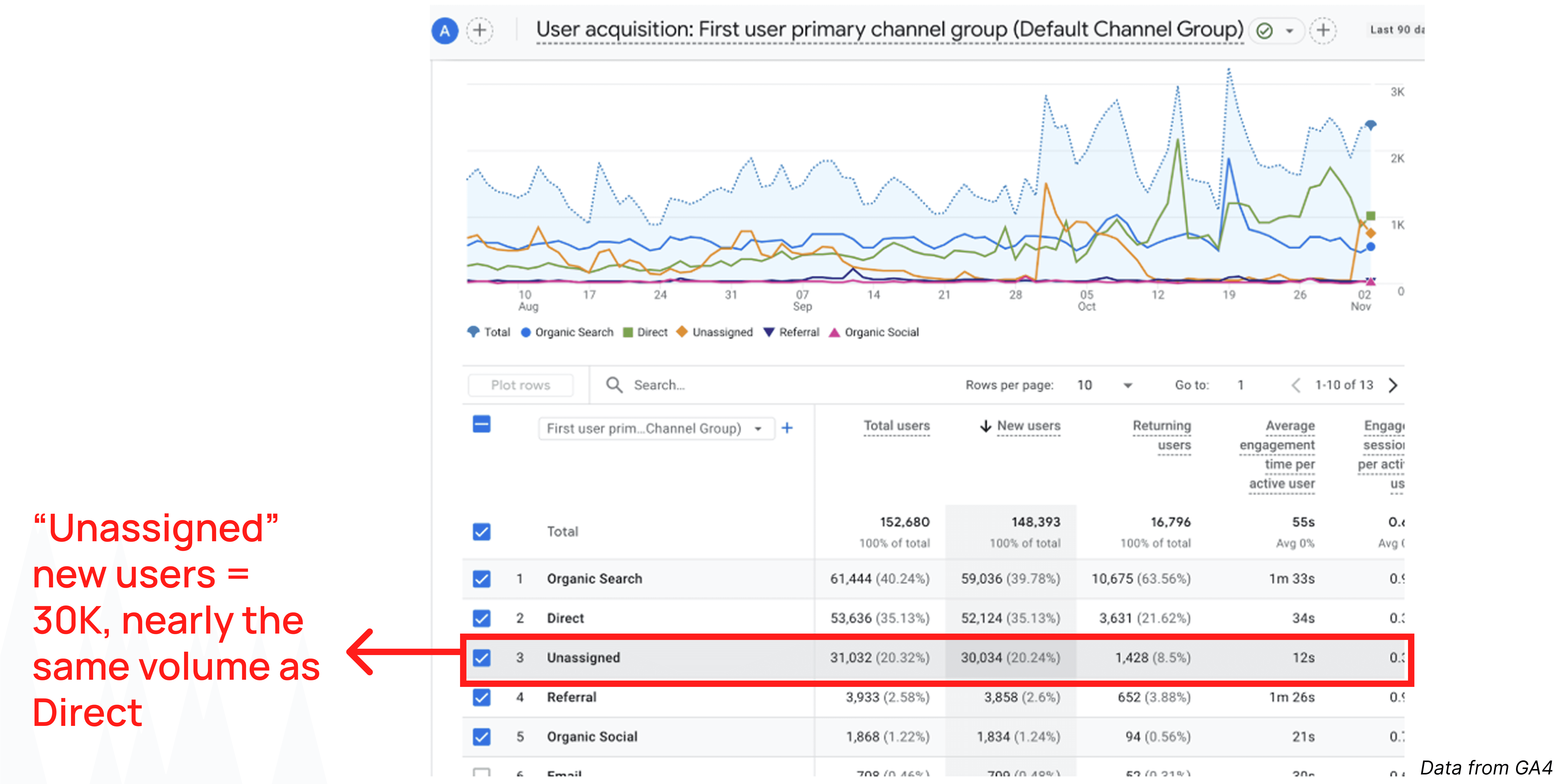
This prevents the museum from understanding where to invest, what content works, and how campaigns support visitor engagement.
Recommendation 3
QUICK WIN
To address this, we recommend conducting an audit on all major inbound traffic sources to identify missing or inconsistent UTM parameters, especially across newsletters, social posts, partner links, print-to-digital assets, and paid campaigns. Standardize UTM usage across teams and update GA4 channel group definitions so sessions are routed into the correct marketing channels. This ensures accurate attribution, clearer performance insights, and better optimization of future campaigns.
Finding 4
Event Pages Attract High Traffic But Only 5% Conversion Due to UX Friction
Although event pages generate 20K views and high scrolling engagement (2,117 dwell/scroll actions), only 995 Eventbrite RSVP clicks occur with just a 5% conversion rate.
This indicates that users are interested, but the current event-page layout creates friction in the journey from viewing → engaging → registering. The primary drop-off occurs before the RSVP button is clicked, implying the CTA isn’t easily found, isn’t compelling, or requires too much scrolling before discovery.
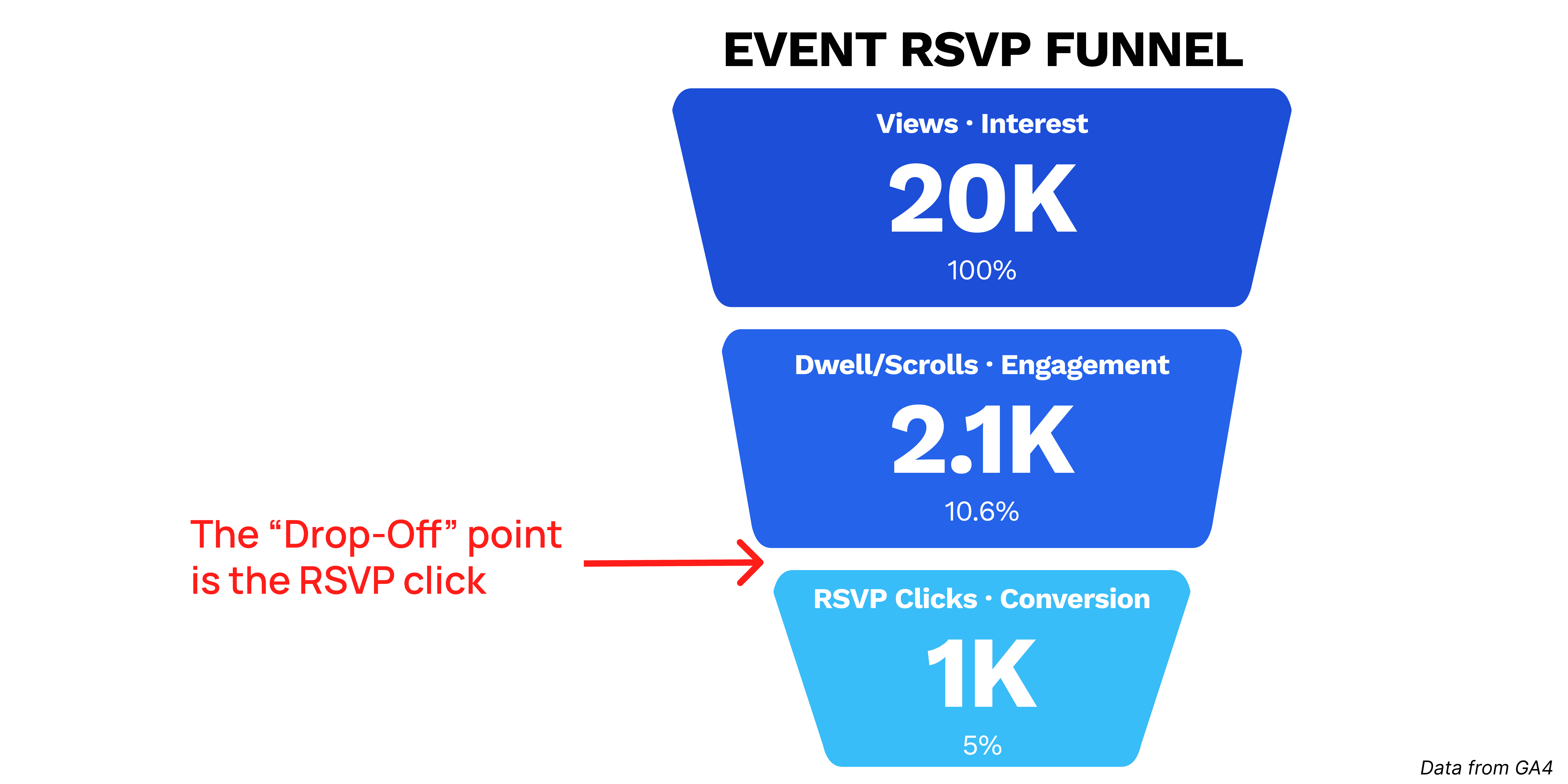
This conversion gap means the current marketing is working, but the website experience is not supporting registration, directly impacting attendance and programming success.
Recommendation 4
HIGH IMPACT
To address this, we recommend redesigning the event page template so that the primary CTA (“RSVP,” “Register,” “Get Tickets”) is placed prominently above the fold, add a sticky CTA that follows the user down the page ensures the path is always available, and follow with heatmap and scroll-depth UX analysis to identify friction points in the layout, remove unnecessary barriers, and streamline the path from interest to registration.
Finding 5
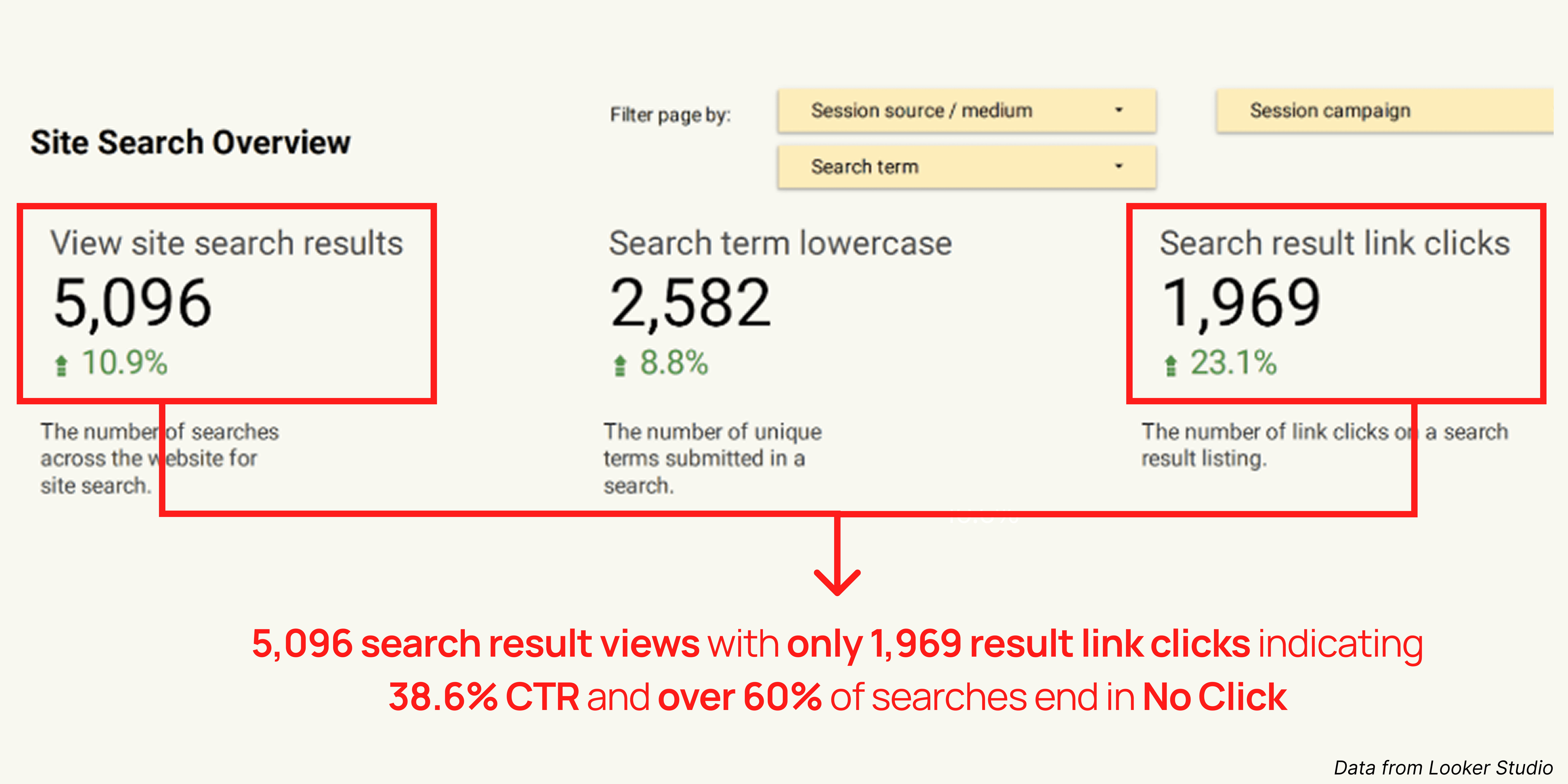
Site Search has High Usage but Low Click-Through, Indicating Relevance & UX Issues
The current site-search data from Looker Studio shows that over 60% of searches end in no result click, meaning users either can’t find what they need or the UI fails to guide them effectively.
Slow performance discourages deeper exploration, reduces session duration, and limits how effectively users engage with important content such as exhibitions, education pages, and event listings.
Recommendation 5
LONG-TERM
To address this, we recommend manually testing the top 20–30 queries to evaluate relevance and identify gaps in content indexing. Improve search result quality by tuning the algorithm, updating metadata on underperforming pages, and addressing content mismatches. Implement autocomplete suggestions, synonym handling, and filtering options (e.g., Artists, Collections, Events, Educator Resources) to guide users more effectively. These enhancements can increase search clarity, reduce zero-click searches, and raise the search result click-through rate toward a target of 60%+.
• DASHBOARD EVALUATION & MOCKUP
Evaluating the Carter’s Dashboard: Are We Measuring What Matters?
After analyzing SEO, Web Performance, and Instagram, it became clear that the Carter’s biggest challenges were also about data clarity. We started analyzing their Looker Studio dashboard and we repeatedly encountered issues where metrics were misleading or obscured by noise:
bot-heavy cities inflating engagement,
duplicate domains fragmenting authority,
misattributed sessions masking true marketing performance.
Because of this, we expanded our audit to include a dashboard evaluation, ensuring the museum had the tools to measure improvements accurately.
Our dashboard recommendations, bot filtering, annotation of unassigned traffic, and repairing broken Looker Studio charts, became a crucial final phase that tied all insights together.
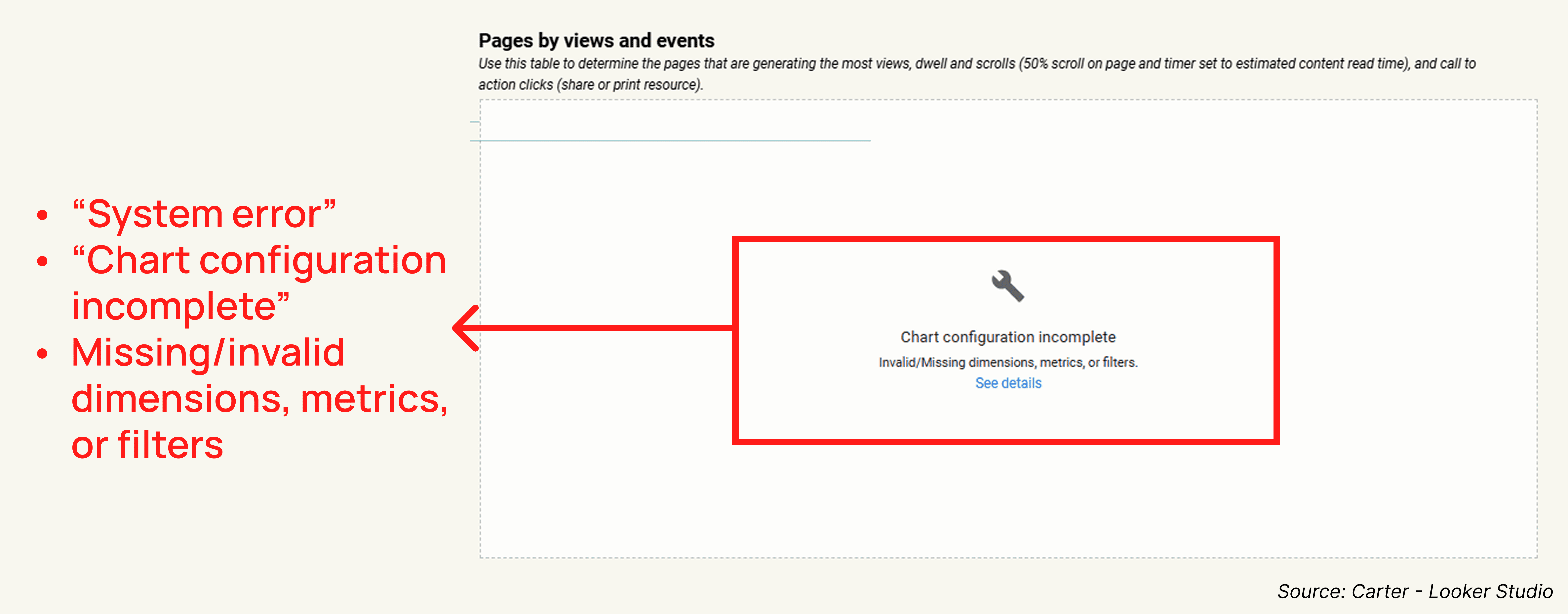
Issue 1:
Critical Charts Are Broken, Hiding Key Content Engagement Patterns
The “Collections Engagement” page displayed: “System error”, “Chart configuration incomplete”, and Missing or invalid dimensions and metrics.
This made the dashboard unusable for understanding which collections drive the most engagement which is a major gap for a museum.
Recommendation 1:
CRITICAL
To address this, we recommend reconnecting the data source in Looker Studio and ensure valid dimensions (e.g., Page URL), metrics (e.g., Event Count), and correct field types in the GA4 property. Once fixed, the museum can finally see which artworks, categories, and themes perform best.
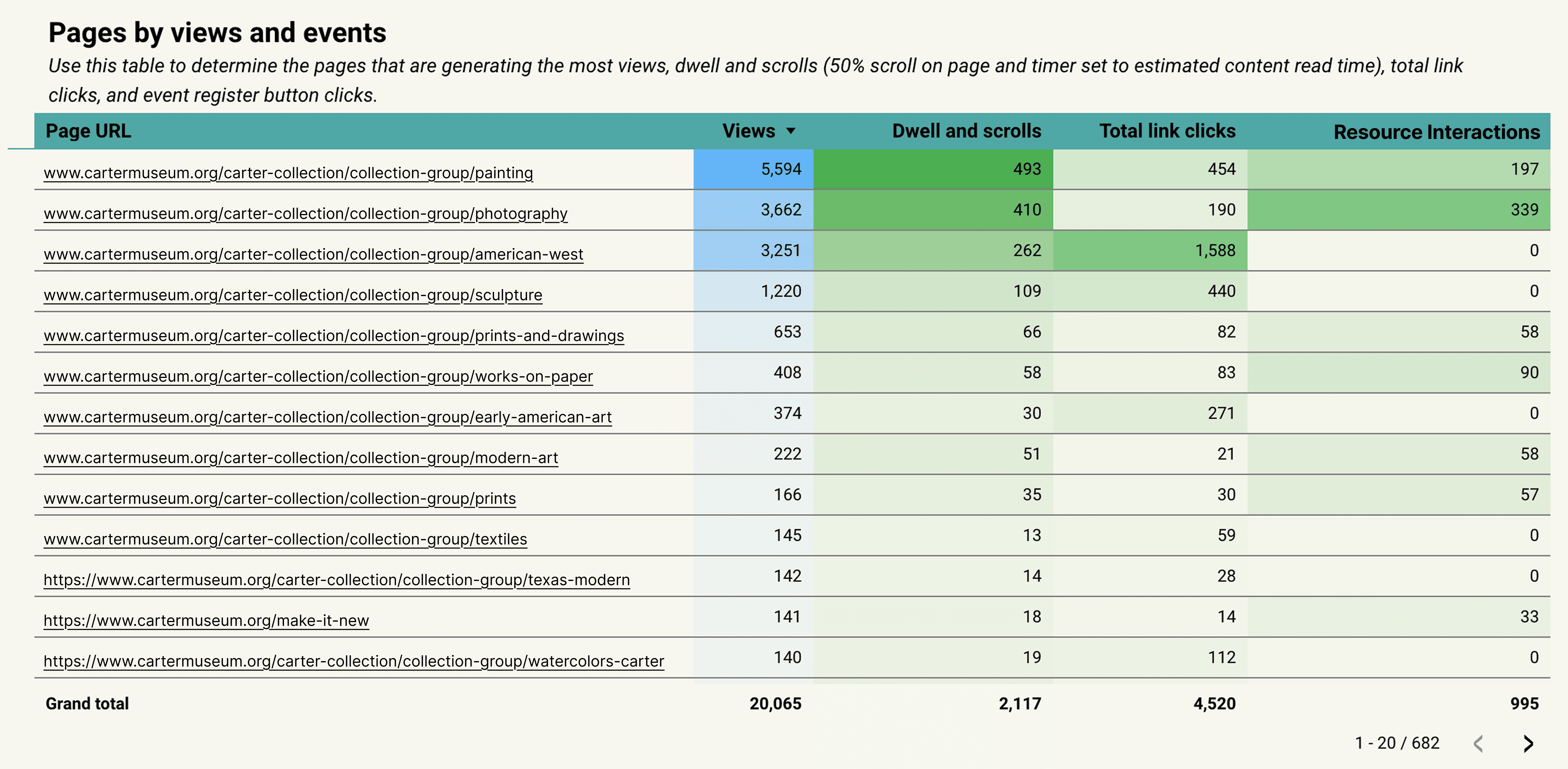
Mockup of Pages by View and Events Component in Collections Engagement
Issue 2:
Bot Traffic Inflates Engagement Metrics
Cities like Lanzhou, Shanghai, Singapore, Hangzhou, and Ashburn appeared at the top of the Sessions table — but with extremely low engaged-session counts, signaling bot presence.
This artificial traffic inflated metrics such as: Average engagement time, City-level traffic patterns, and Resource interaction counts.
Recommendation 2:
CLARITY
To address this, we recommend creating a dashboard filter to exclude traffic where City = [Bot-heavy cities]. This restores a realistic view of human behavior and prevents misleading interpretations.
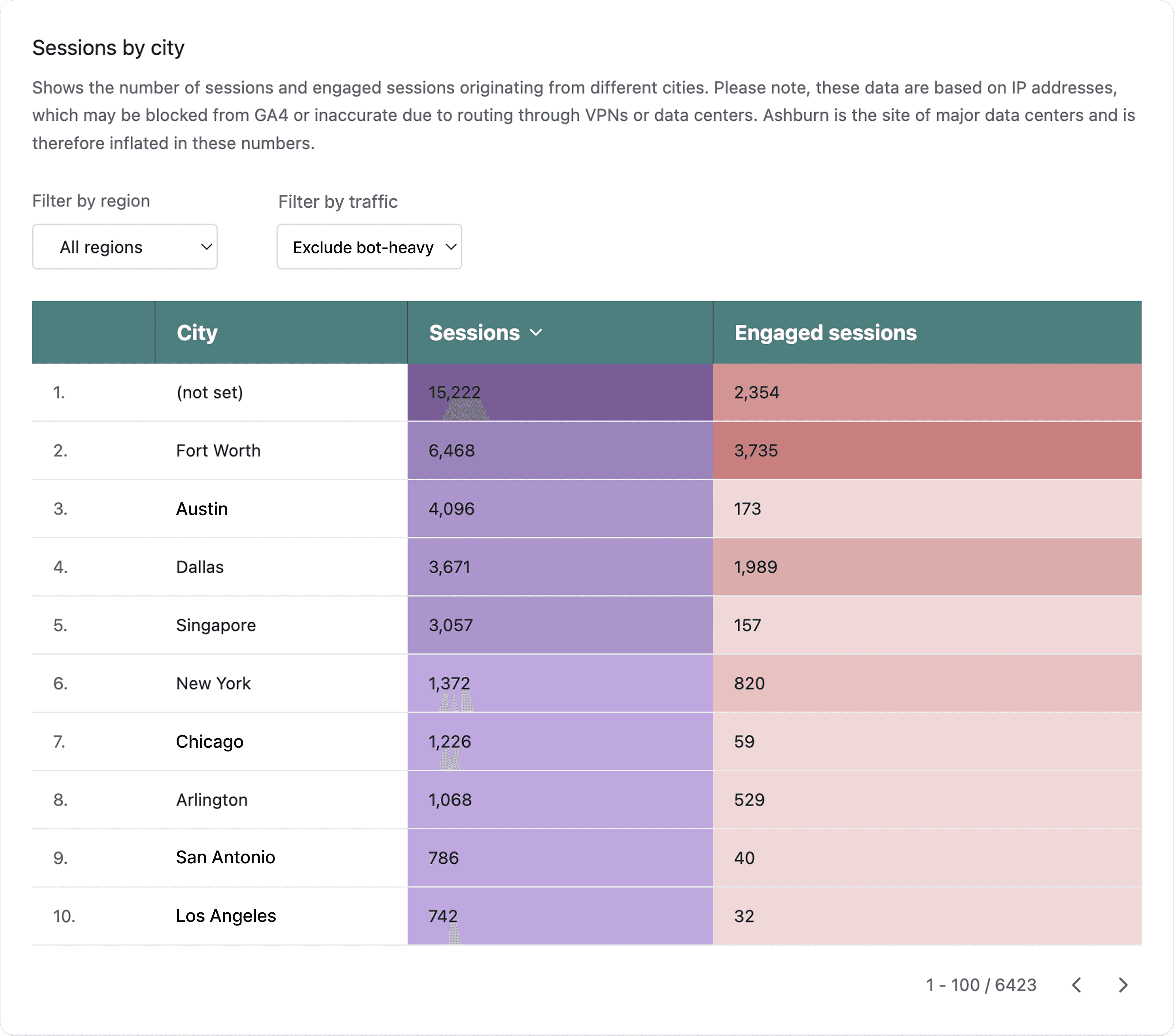
Mockup of Sessions by City Component with Exclude Bot-Heavy filtered
Issue 3:
“Unassigned” Traffic Misleads Attribution Understanding
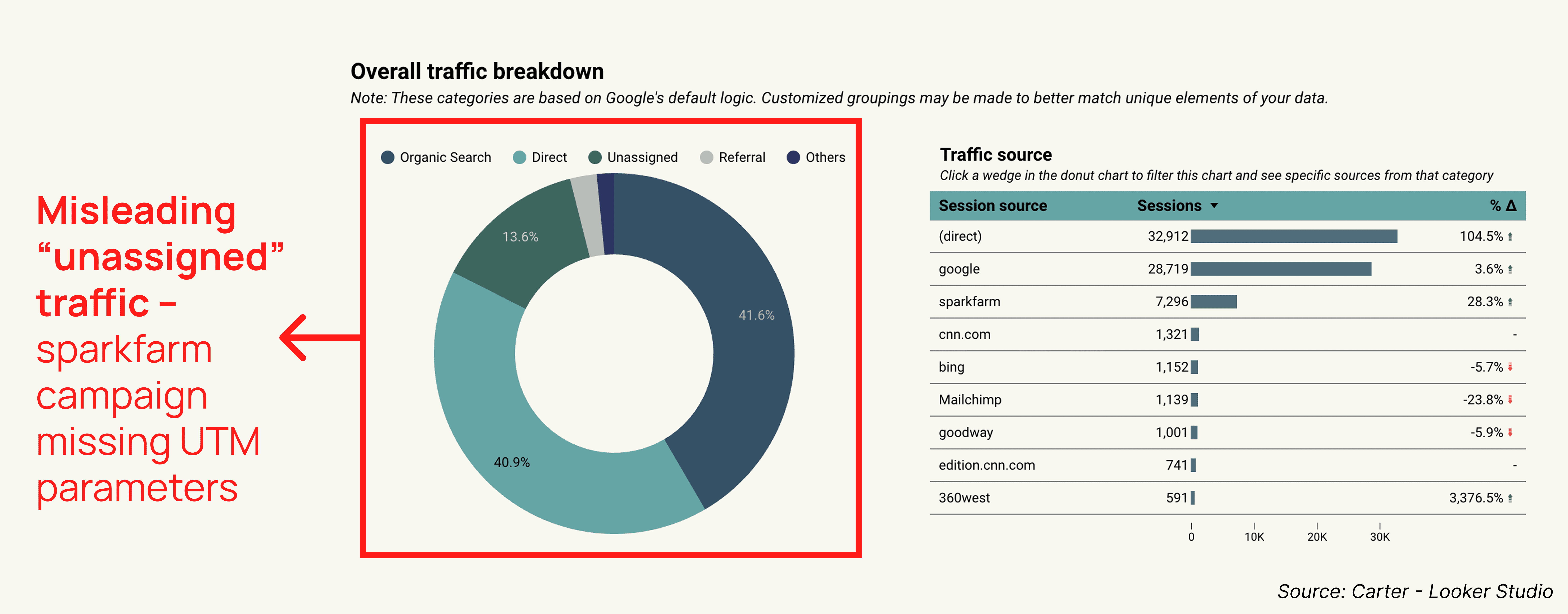
“Unassigned” showed up as the third-largest traffic source. Upon inspection, it came from the sparkfarm campaign, which lacked UTM parameters, making GA4 unable to categorize it. This distorted the Carter’s understanding of channel performance, campaign ROI, and marketing investment decision-making.
Recommendation 3:
CLARITY
To address this, we recommend adding a text box annotation next to the "Traffic Sources" chart explaining that "Unassigned" traffic is largely due to the sparkfarm campaign missing standard UTM parameters.
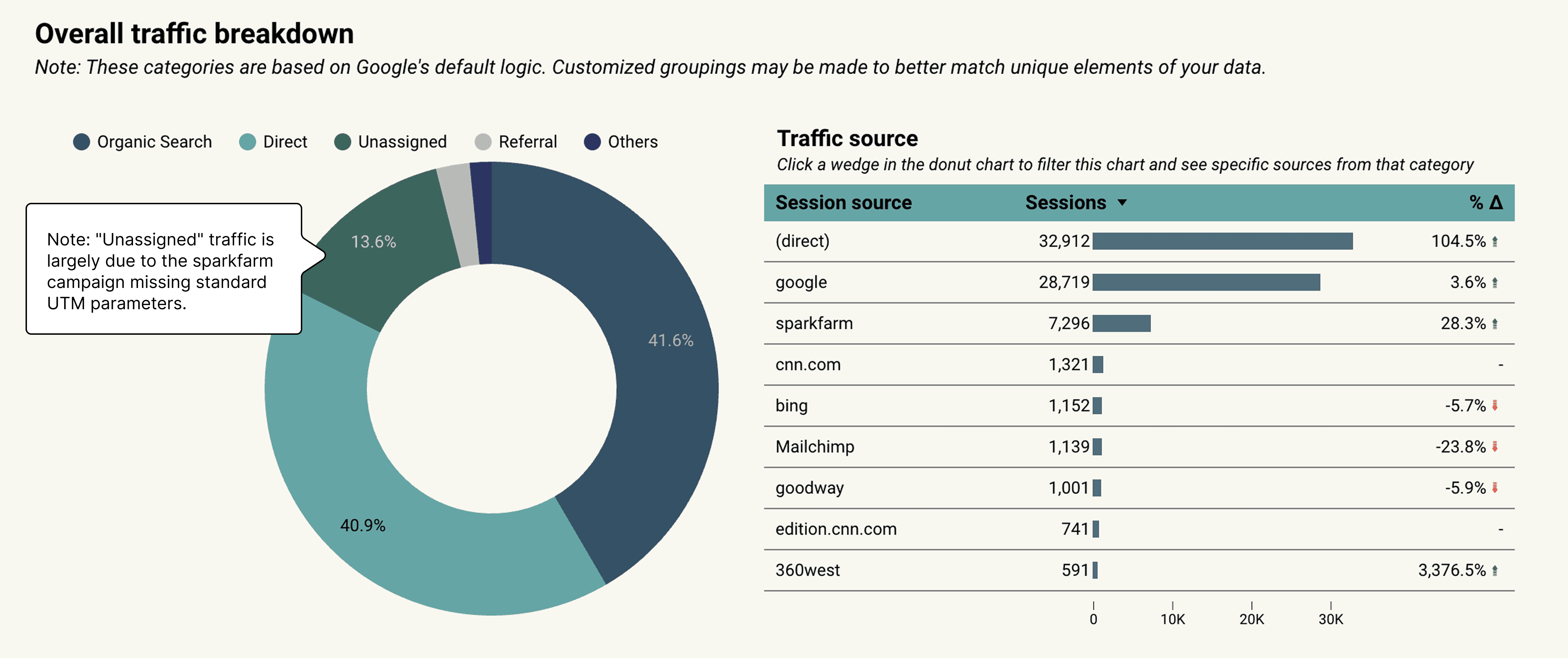
Mockup of Overall Traffic Breakdown with Text Box Annotation to Traffic Sources
• OUR FINAL STRATEGY
A Unified Digital Growth Strategy: Turning Visibility Into Measurable Action
Across SEO, Web Performance, Instagram engagement, and dashboard evaluation, our audit revealed a clear pattern: the Carter attracts strong attention, but its digital ecosystem is not yet set up to convert that attention into discovery, engagement, and action.
To close that gap, we developed an integrated roadmap that aligns how users find the Carter, how they behave on the site, and how off-site influence (Instagram) can better support conversion.
Our strategy focuses on four pillars
Strengthening the Foundation
Consolidate duplicate domains, improve search relevance with high-quality anchor text, enable faster load times, and ensure all marketing traffic routes into clean, trustworthy attribution. This establishes a strong, authoritative foundation for users to discover the Carter through accurate, high-quality visibility.
Reducing UX Friction
Redesign event pages so CTAs appear where users actually look, clarify search pathways by fixing indexing and metadata gaps, and improve content structure so users can browse, scroll, and convert with ease.
Elevating Storytelling to Drive Engagement
Shift Instagram from flyer-style announcements to rich, human-centered storytelling featuring curators, artists, educators, and community voices. Convert static posts into 2–5 frame carousels and build a long-term “museum stories” reel library that increases reach, saves, shares, and website traffic.
Improving Measurement and Insight Quality
Redesign the analytics dashboard to surface accurate, actionable insights by filtering bot-heavy cities, annotating “unassigned” traffic, repairing broken charts, and highlighting high-intent behaviors. This ensures decisions are based on trustworthy, human-centered data.
Together, these four pillars create a cohesive, scalable digital growth framework that strengthens discoverability, reduces friction, elevates storytelling impact, and ensures reliable measurement, ultimately turning visibility into meaningful action.
• CLIENT IMPACT
From Insights to Impact: Presenting Our Strategy at Nasdaq With the Carter Team
We were honored to present our strategy at Nasdaq, alongside our clients Michelle and Clara and our professor. The session marked the first time the Carter team saw their entire digital ecosystem, SEO, analytics, content, and UX, connected into one cohesive story.
During the presentation, the team shared that our audit helped them articulate issues they had long suspected but could never clearly diagnose.
Some highlights they emphasized:
Our findings finally explained why Instagram’s strong engagement wasn’t translating into site traffic.
The bot-inflated city data had caused confusion for months, our filter proposal immediately clarified engagement metrics.
They appreciated that our recommendations were practical, actionable, and directly tied to the museum’s real behavior patterns, making the next steps feel achievable rather than overwhelming.
The Carter team left the session with a renewed understanding of how their digital ecosystem functions and a clear roadmap for strengthening it.
• OUR REFLECTION
What I Learned from this Project and What Surprised Me?
Using Digital Analytics as UX Evidence, Not Just Measurement
As a UX designer, this project showed me how powerful digital analytics becomes when used not just to report performance but to explain UX behavior. Metrics like scroll depth, CTA visibility, and route attribution helped surface friction points that traditional usability testing might not immediately reveal.
A memorable example was the “high traffic but low conversion” pattern on event pages. Analytics allowed us to pinpoint why users weren’t converting which is the CTAs were placed too low, essential info required scrolling, and mobile layouts weren’t aligned with user behavior. Data didn’t just describe the problem; it illuminated the path to a UX solution.
This project taught me how to use analytics as evidence-based UX design input, guiding more confident, defensible recommendations.
Duplicate Domain and Bot Traffic Surprised Me
These two insights were particularly unexpected. The duplicate domains were quietly weakening the Carter’s authority online which is something even the client didn’t realize was impacting SEO strength. Bot traffic from cities like Lanzhou and Shanghai significantly distorted engagement metrics. Recognizing this pattern allowed us to reveal the museum’s true audience behavior.
These moments taught me how analytical anomalies often point to deeper systemic issues, and how solving them strengthens every part of the digital ecosystem.
Communicating Complex Insights With Confidence
One of the biggest skills I developed was learning to translate dense analytics into clear, compelling, and accessible storytelling, especially for stakeholders who don’t come from data or technical backgrounds.
This experience taught me that the value of data doesn’t come from complexity, but from clarity, narrative, and usability, the same principles that make great UX.
• SOCIAL MEDIA ANALYSIS
Social Media Analysis:
How Effectively Is the Carter Performing on Instagram?
Once we understood how visitors behaved on the Carter’s website, our next step was to examine what draws them there in the first place. During our kickoff conversation, the Carter team emphasized that Instagram is their primary social platform. With event conversions lagging and CTAs underperforming on-site, we needed to evaluate whether Instagram’s storytelling was effectively building interest, emotional connection, and motivation to visit.
This led us to analyze how the Carter communicates on Instagram: who they reach, which narratives resonate, and why website clicks remain disproportionately low despite strong engagement. Instagram became the critical bridge—yet also the bottleneck—between awareness and action.
Finding 1
Instagram Audience Skews Midlife and Female, Limiting Reach to Younger Segments
Instagram data shows that 56% of the Carter’s audience is between ages 35–54, with a 2:1 female-to-male ratio. Younger audiences, especially 18–34, the core demographic for Instagram, remain significantly underrepresented.
This skew indicates that current content formats and storytelling approaches resonate more with existing midlife followers than with next-generation museum visitors.
Finding 2
Carousel Posts Outperform Static Images by 56%, but Make Up Only 14% of All Content
Carousel posts deliver +56% higher engagement than single-image posts, but represent only 14% of total output. Static images dominate the feed (86%), despite underperforming on both impressions and engagement.
Finding 3
Human-Centered, Interactive Stories Drive the Highest Completion Rates
Stories featuring people, partners, food activations, and behind-the-scenes moments consistently top performance charts, with completion rates around 93%.
Instagram’s algorithm heavily favors faces, motion, and community presence. The Carter’s top performers reveal that audiences want human connection, not static announcements or flyers.
Finding 4
Massive Untapped Opportunity in Reels — Only 17 Posted in 365 Days
Despite Reels being Instagram's highest-reach format (2025), the museum posted only 17 Reels over the past year. These Reels averaged 1,774 plays each with 4.5% engagement rate - exceeding engagement rate vs. posts. This represents the single biggest growth opportunity, as the highest reel played 4.8K times.
Reels represent the single largest growth lever for the Carter. Posting so few reels prevents the Carter from competing in algorithmic discovery and significantly limits reach among younger audiences.
Finding 5
Instagram has Strong Local Foundation but Untapped Regional Potential
Fort Worth represents 20.5% of the total audience (5,430 followers), with the broader DFW metro area comprising 31% (8,205 followers). This strong, local foundation is ideal for museum visitation conversion.
However, limited penetration in Dallas suburbs (Plano, Irving, Frisco) represents growth opportunity.
With visitation relying heavily on local audiences, expanding regional awareness is a critical growth opportunity, especially for exhibitions, events, and educational resources.
Finding 6
Strong Engagement (Up to 12%) but Critically Weak Website Conversion (Only 220 Clicks from 2.6M Impressions)
The museum demonstrates exceptional content capability with top posts achieving 10-12% engagement rates - well above the 3-6% museum industry benchmark. However, this engagement can be optimized for business outcomes: only 220 website clicks from 2.6M impressions (0.008% CTR) and minimal profile-to-website conversion despite 2,677 profile visits.
The Carter excels at attention and retention, but struggles to convert engagement into meaningful outcomes like visit actions and event registrations. The current link-in-bio setup is not working.
Finding 7 - Competitor Analysis
Museums Win on Instagram When They Lead With Voice, Trailers, and Experience-Driven Storytelling
Across all benchmarked institutions, such as Kimbell Art Museum, the Modern Art Museum of Fort Worth, Crystal Bridges, and Westmoreland , they all share one pattern: the museums that perform best on Instagram consistently lean into three content strengths: human voice, cinematic exhibition trailers, and immersive experience-based storytelling.
Competitors’ highest-engagement posts showcase curators and artists speaking directly to the audience, dynamic trailer-style Reels that build anticipation, and in-the-moment experiences featuring people, movement, and partnerships.
They all sees weak performance from static promotional flyers and routine announcements, confirming that Instagram rewards emotional connection, motion, and narrative over institutional messaging.
Recommendations:
Rich, Story-Driven Content Is the Key to Growth and Conversion
Our Instagram analysis shows a consistent pattern across audience demographics, content performance, Reels, Stories, geographic reach, funnel outcomes, and competitor benchmarks: static, flyer-style posts underperform, while human-centered, narrative formats drive significantly stronger engagement and reach.
The Carter’s current Instagram audience is highly concentrated (ages 35–54, majority female), and while engagement on individual posts is strong, website conversions remain extremely low (0.008% CTR). Reels, Stories, and human-driven content dramatically outperform, yet are underused. Competitor museums across the region and nation also strengthen this insight: their highest-performing content consistently features voice (curators, artists), trailers (cinematic previews), and lived experience (behind-the-scenes, in-the-building moments).
To expand reach to younger audiences, strengthen regional visibility, and turn engagement into meaningful actions (profile taps, saves, website clicks, and in-person visits), the Carter must shift from announcements to storytelling.
Rich, human, save-worthy content is the clearest pathway to improving visibility, relevance, and conversion on Instagram.
Recommendation 1
HIGH IMPACT
Quick, Human Moments
Recurring, human-centered content that co-storytells the Carter experience through artists, staff, curators, teachers, partners, and behind-the-scenes voices. This type of content is informative while adding the opportunity for call-to-actions.
Recommendation 2
QUICK WIN
Carousel > Static Post
Take the existing “flyer content” such as event announcements, exhibition reminders, and convert them into 2–5 frame carousels. Frame 1 should sell the swipe, the middle frame delivers depth (ie. behind-the scenes, key facts, or short quotes), and the last frame should provide a recap so that the post is save-worthy.
Recommendation 3
LONG-TERM
Build a Reel-based “Museum Stories” content Library
Develop a long-term pipeline of rich short video contents such as: behind-the-scenes (BTS) moments, Q&A series, exhibition walkthroughs, artists speaking about their work, or community/education event moments.