Elevating Welcoming Experience For Visitors At Pratt
overview
Every year, prospective students and their families walk through Pratt’s campus trying to imagine themselves as part of the community. Student ambassadors play a critical role in shaping these first impressions, guiding visitors, sharing personal experiences, and answering questions during a pivotal decision-making moment.
This project focused on improving Pratt’s campus visit experience as an end-to-end service. By mapping the current experience, analyzing visitor feedback, and collaborating with student ambassadors, we identified gaps across communication, wayfinding, and post-visit support. Our goal was to ensure that every visitor leaves campus with clarity, confidence, and a genuine sense of being supported, not just during the tour, but beyond it.
my contributions
I led service research and intervention design across the end-to-end visitor experience, conducting service safaris, mapping the current journey, and analyzing post-tour survey data to identify recurring gaps. I co-facilitated two co-design workshops with student ambassadors to surface frontline insights and operational constraints, then translated those findings into feasible service interventions. I also shaped the storytelling and final presentation, clearly communicating research insights, design rationale, and impact to Pratt Visitor Services stakeholders.
year
2025
duration
9 weeks, Oct 2025 - Dec 2025
tools
Figma, Google Doc, Zoom
artifacts
Service Blueprint, Ecosystem Loops, Co-Design Workshop Toolkits, Ambassador Training Materials, Updated Visitor Welcome Packet
category
Service Design
client
Pratt Visitor Services
my role
Service Design Consultant
team
Gloria Yang (Me) Atharva Nayak Sakshi Rane
See how this translated into real service changes
Click to View Interventions ↓
• THE BACKGROUND
How Does Current Service Work?
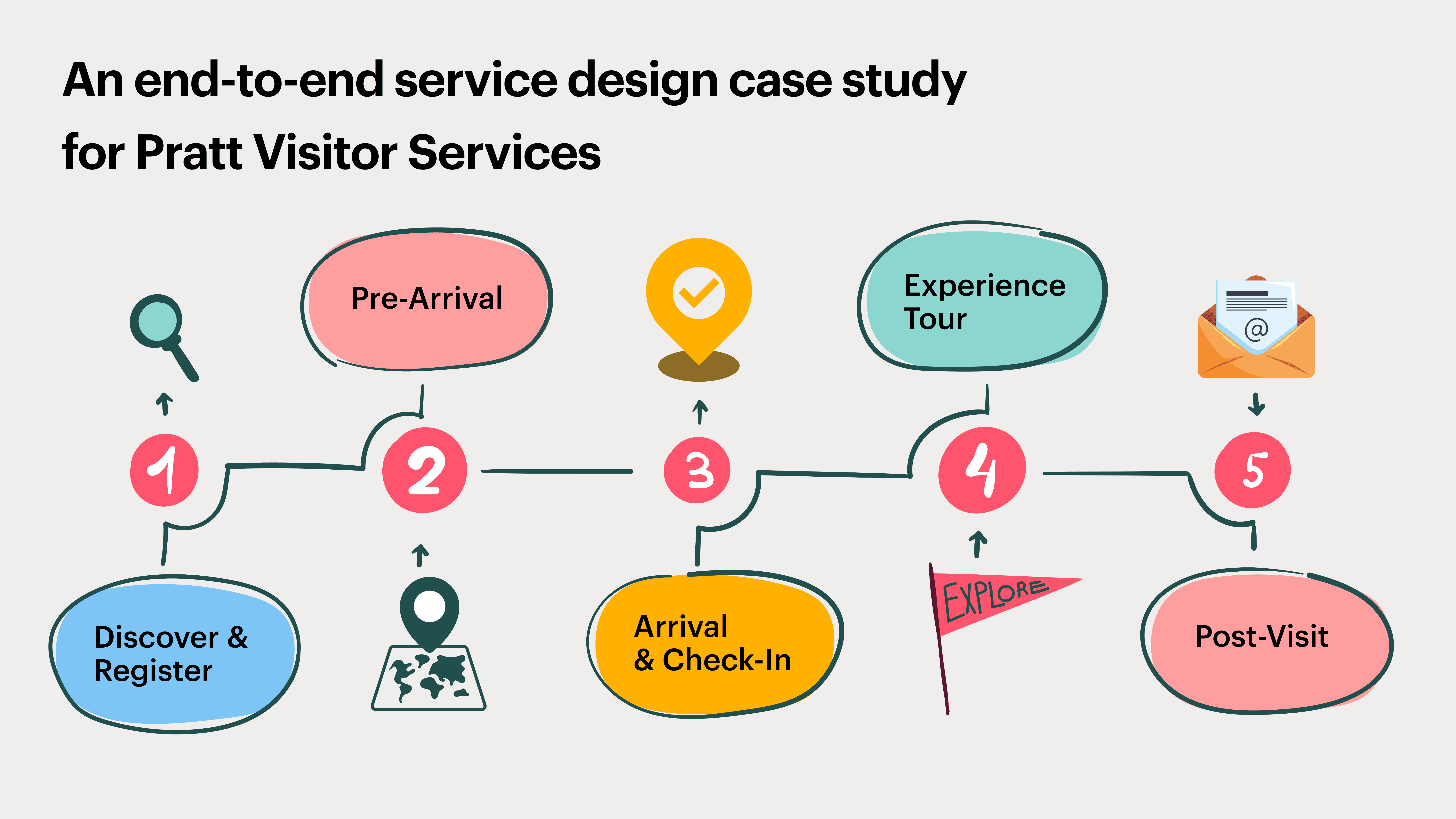
Before proposing improvements, we conducted a service safari to experience the campus tour firsthand and mapped the visitor journey from the user’s perspective. This helped us identify the key touchpoints, decisions, and moments of friction that shape prospective students’ first impression of Pratt, from discovery and registration to tour preparation.
Phase 1 Discover & Register – Visitors can find tour information, but the process lacks clear expectations about what the visit will include and how to prepare.
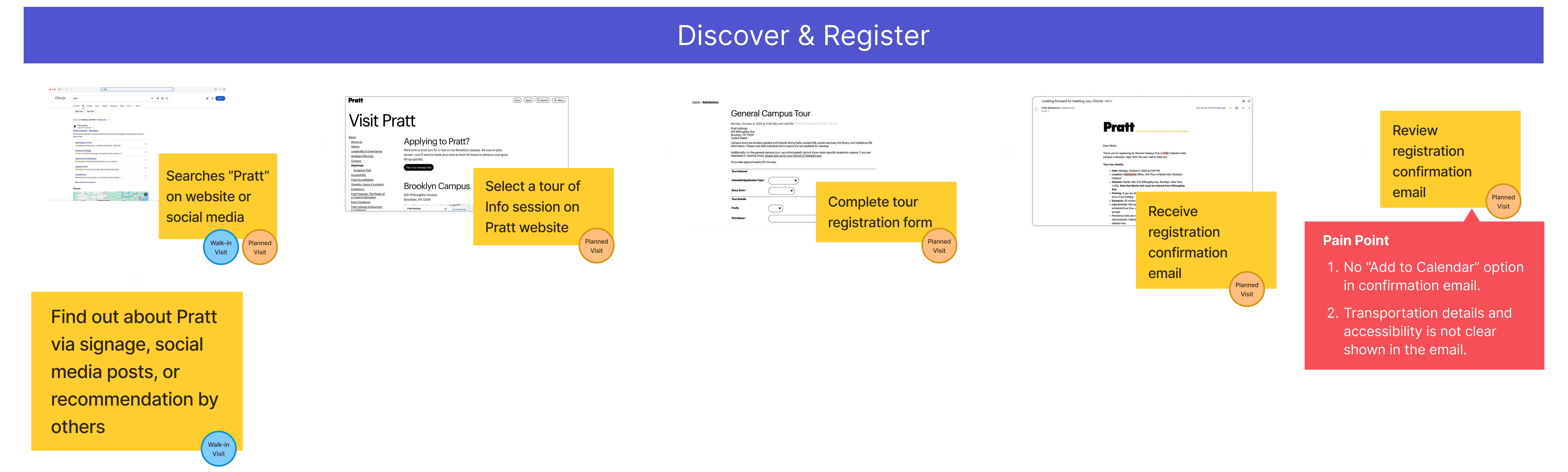
Current Visitor Journey: Discover & Register
Phase 2 Pre-Arrival – Visitors arrive feeling uncertain and anxious before they step on campus due to unclear logistical guidance.
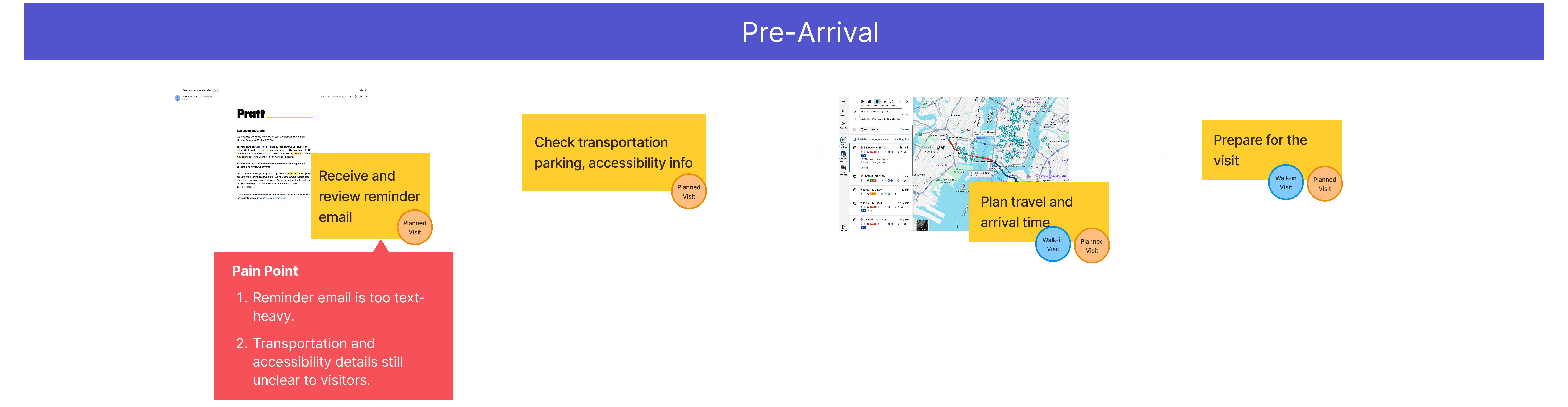
Current Visitor Journey: Pre-Arrival
Phase 3 Arrival & Check-In – The first in-person touchpoint feels procedural and intimidating, missing an opportunity to create a warm welcome.
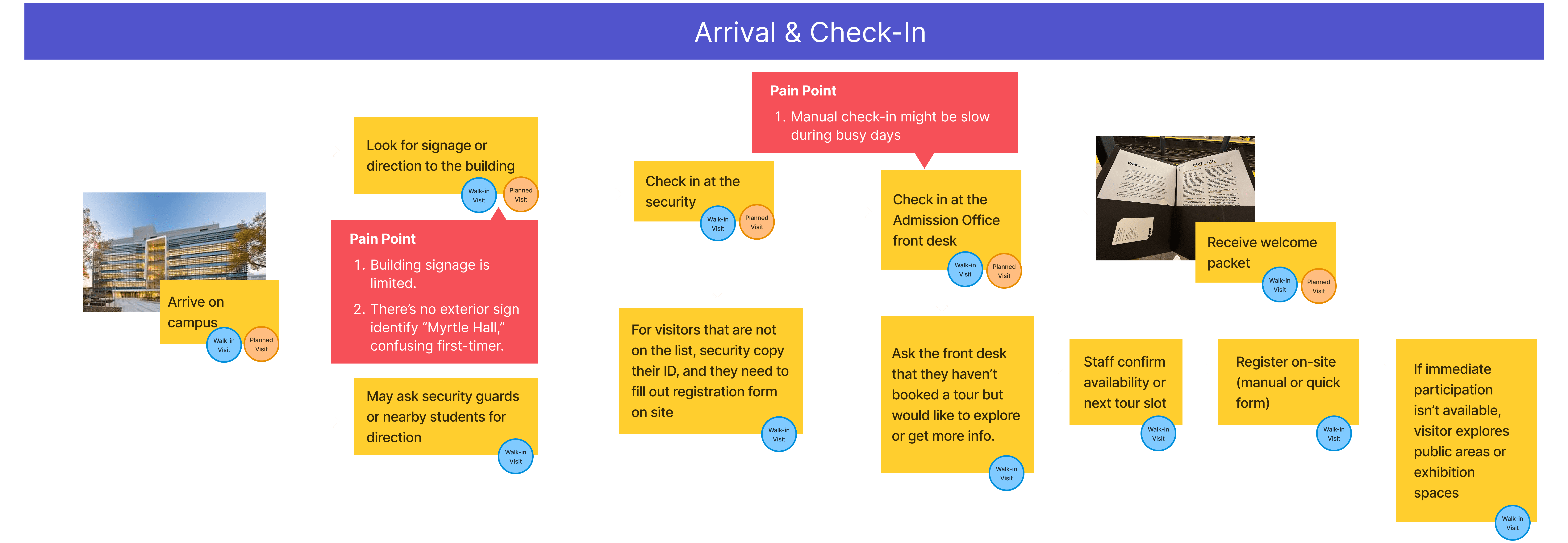
Current Visitor Journey: Arrival & Check-In
Phase 4 Experience Tour – Tour quality varies depending on the student ambassador, leading to inconsistent storytelling and uneven visitor experiences.
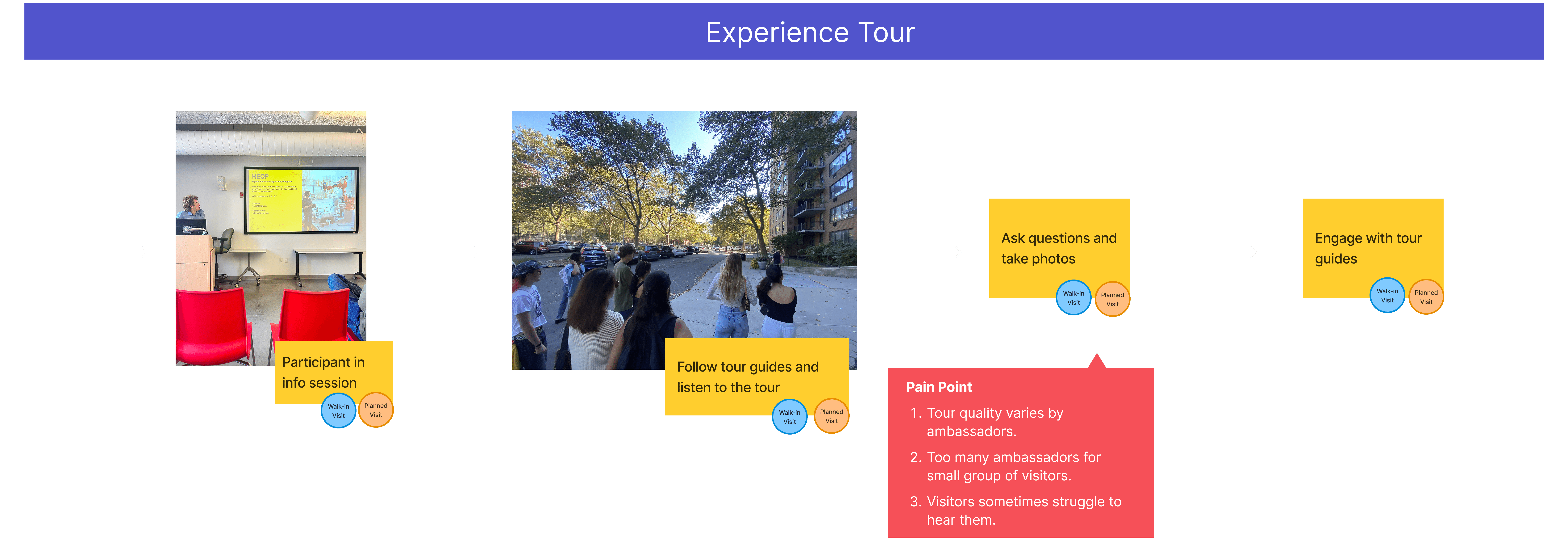
Current Visitor Journey: Experience Tour
Phase 5 Post-Visit – Generic follow-ups and limited next steps fail to reinforce confidence or support decision-making after the tour.
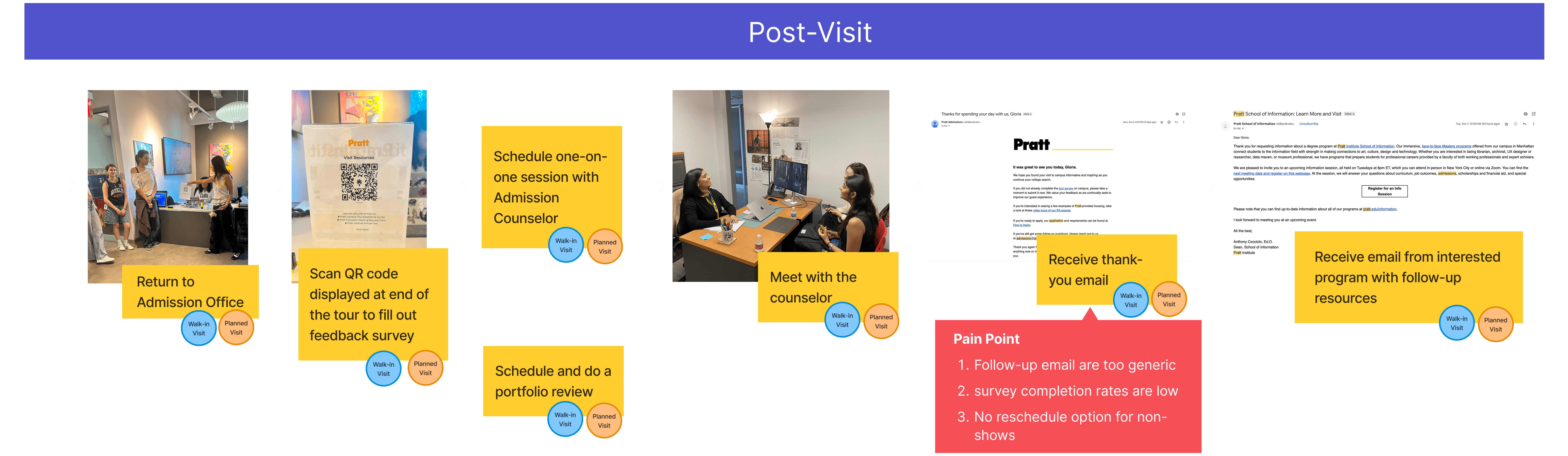
Current Visitor Journey: Post-Visit
Key Insights
Looking across the journey as a whole, several recurring themes emerged that shape how visitors perceive Pratt before, during, and after the tour.
Pre-visit guidance is unclear
Visitors lack clear logistical and expectation-setting information before arriving on campus.
Arrival feels intimidating, not welcoming
Lack of wayfinding create stress rather than a sense of hospitality.
Tour quality varies by ambassador
Inconsistent delivery affects how visitors perceive Pratt's overall experience.
Post-Visit engagement fails to build confidence
Generic follow-ups and no reschedule option for no shows
• ECOSYSTEM LOOPS
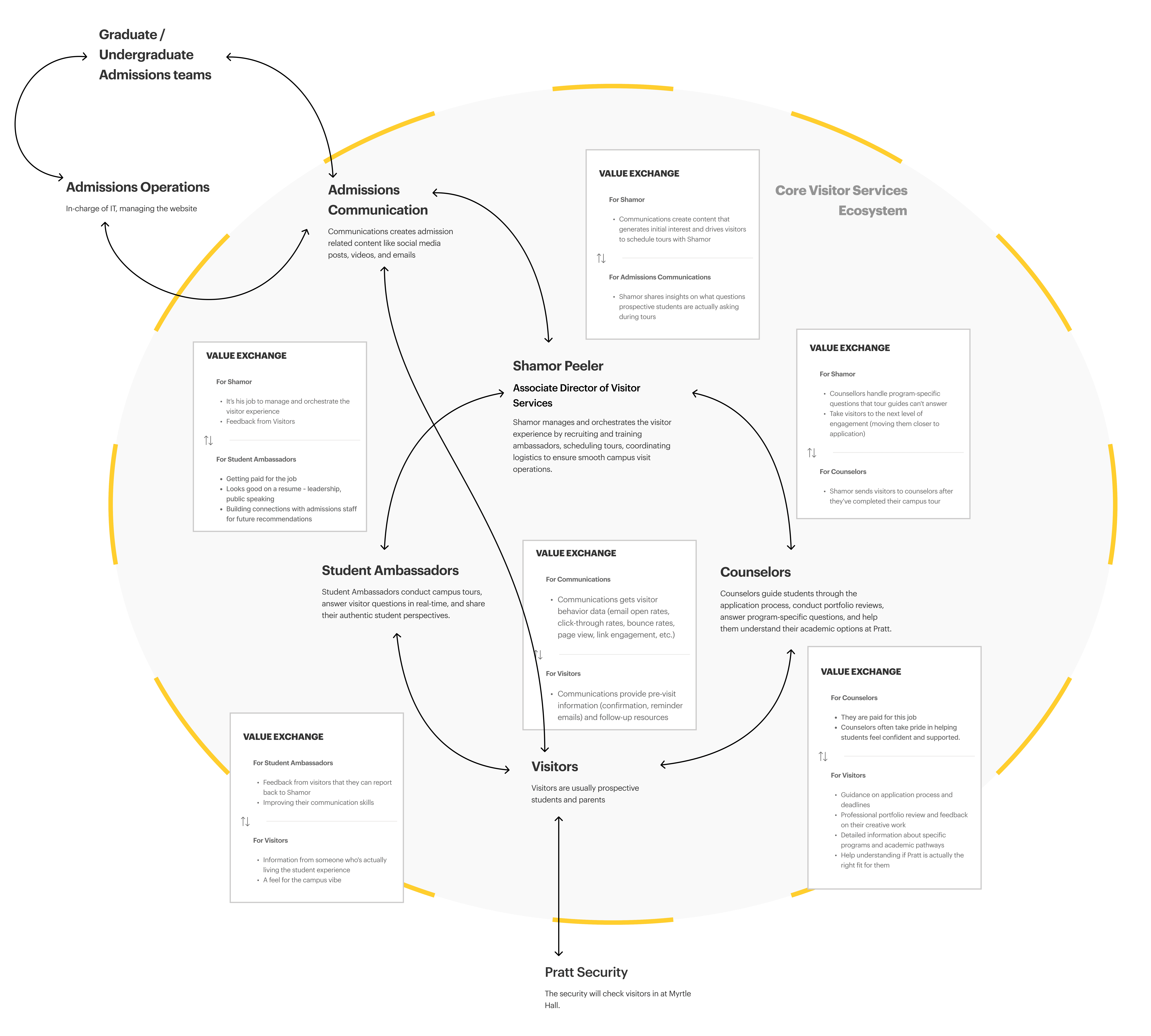
Key Characters in the Visitor Experience
The visitor experience at Pratt is shaped by multiple actors—visitors, student ambassadors, admissions leadership, counselors, communications teams, and institutional systems—working together across different touchpoints.
Each actor plays a distinct role, and the value exchanged between them creates feedback loops that keep the service running, adapting, and improving over time.
Mapping these ecosystem loops helped us understand how responsibilities, expectations, and emotional labor are shared, and why certain gaps persist across the visitor journey.
• SURVEY DATA ANALYSIS
What the Feedback Survey Revealed
How post-tour survey data confirmed and quantified the observed pain points? We analyzed 718 tour feedback survey responses and built a dashboard to visualize the key insights.
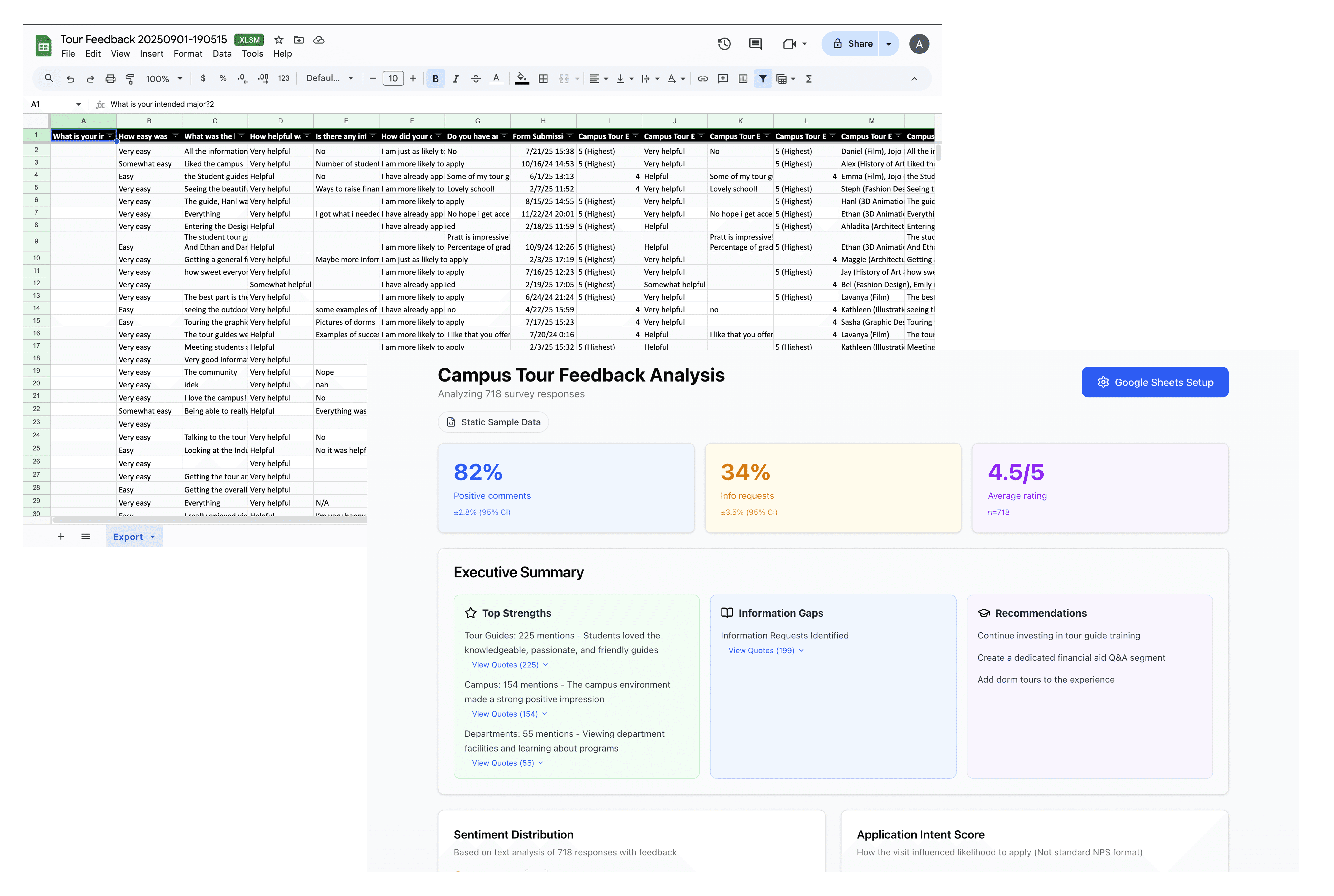
Survey Data Analysis Dashboard and Excel Sheet
Information Gaps
108 information requests surfaced from 220 responses. These reveal the areas where visitors consistently seek more clarity and directly informed which components we prioritized in the welcome packet and ambassador training.
High Priority
Academic Programs & Curriculum (19.9%)
Financial Aid & Scholarships (19.3%)
Medium Priority
Housing & Residential Life (9.9%)
Admissions & Portfolio (6.2%)
Low Priority
Career & Job Outcomes (5%)
Study Abroad Programs (2.5%)
Campus Life & Social (1.9%)
• CO-DESIGN WORKSHOP
Co-Designing with the People Who Deliver the Service
Why We Chose Co-Design?
Co-design brings student ambassadors, the people who deliver the service every day, directly into the improvement process. Their involvement surfaces needs, constraints, and emotional moments that surveys or service blueprints alone cannot fully capture.
Through workshops, we uncovered real operational challenges and day-to-day realities, allowing improvement ideas to be grounded in how the service is actually delivered. By involving ambassadors early and closely, our solutions became more realistic, actionable, and aligned with the lived visitor experience.

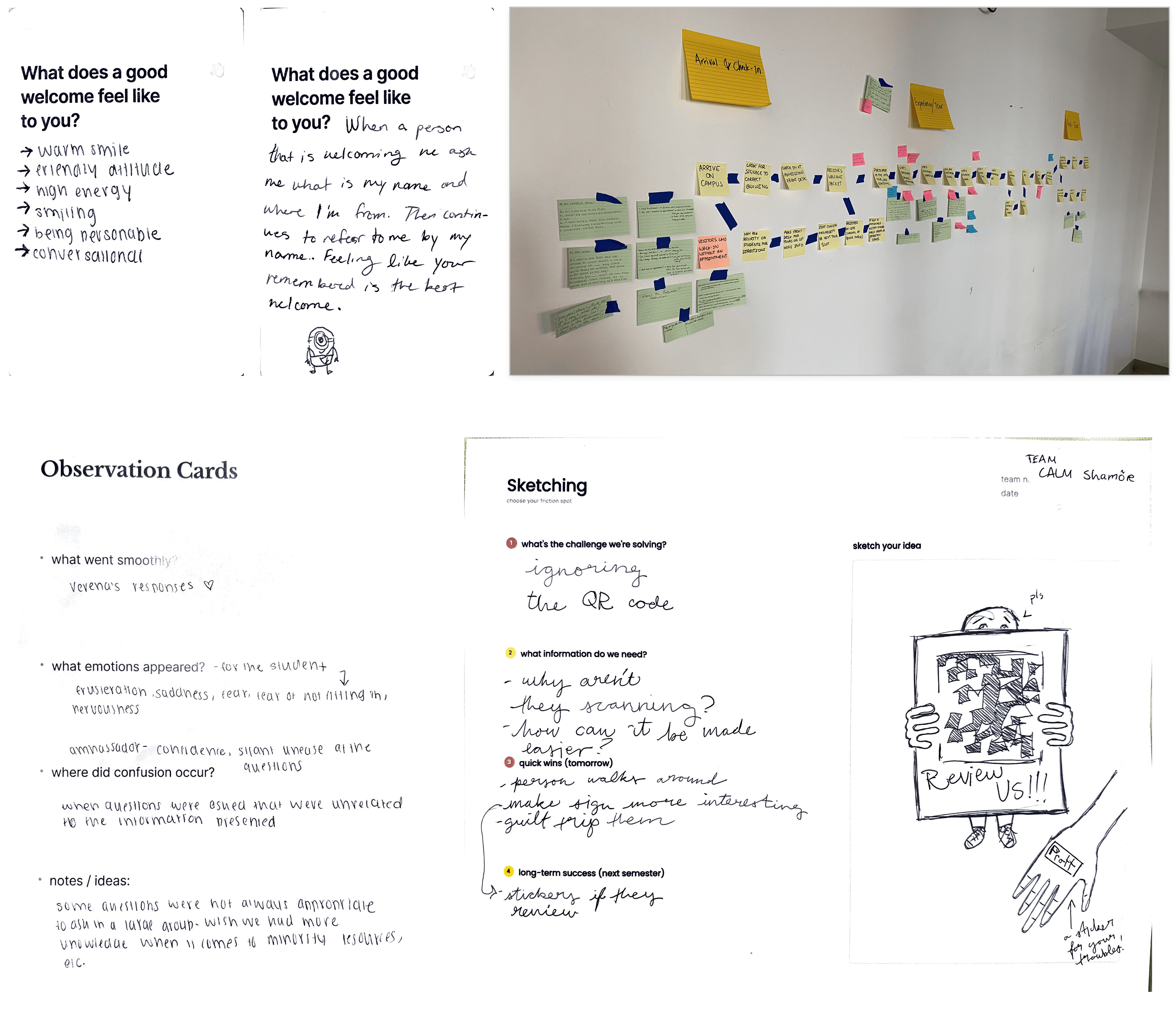
Co-Design Workshop Images
Our Goals
01
Understand the Real Tour Experience from Student Ambassadors
02
Surface the Gaps and Opportunities in Current Experience
03
Co-Create Simple and Feasible Improvements
What We Did?
We hosted two 60-minute in-person co-design workshops with 16 participants, including ambassadors across all tiers and Shamôr. Each session combined reflection, mapping, and creativity to uncover improvement opportunities.
Activities Inlcudes:
A warm-up defining “What Welcome Means”
Visitor journey mapping through the eyes of ambassadors
Role-play exercises to simulate real tour moments
Identifying emotional highs/lows, gaps, and breakdowns
Sketching solutions for a better visitor experience
What We Learned?
Looking across the journey as a whole, several recurring themes emerged that shape how visitors perceive Pratt before, during, and after the tour.
Information Gaps
Ambassadors rely heavily on memory which may inaccurate or inconsistent answers. Need quick-reference tools and clear boundaries.
Emotion Moments Matter
Belonging appears when ambassadors personalize stories. Confusion increases when the route or expectations aren’t clear.
Lack of Update Alignment
Recent changes in campus stops or policies aren’t reaching everyone which directly impacts visitor impressions.
Need Practical & Support Materials
Ambassadors shared their need on updated talking points, transition scripts, scenario responses, and pre-tour prep reminders.
With these insights grounded in real operational constraints, we proposed two interventions to better support both visitors and ambassadors.
• INTERVENTIONS
Intervention 1 – Ambassador Tranining Materials
Student ambassadors play a critical role in shaping visitors’ first impressions of Pratt. However, our research revealed that tour quality varied widely depending on individual experience, confidence, and preparation. To address this inconsistency and reduce ambassador anxiety, we redesigned the training system to provide clearer, more consistent support before, during, and after tours. This approach improves tour consistency across ambassadors, reinforces Pratt’s values through observable behaviors rather than scripts, and shifts training from a one-time onboarding moment to a continuous learning loop that supports ongoing reflection, adjustment, and growth throughout the semester.
A Three-Phase Training Model
Rather than relying on a single onboarding session, we designed a continuous training model that supports ambassadors across three key moments: learning the role, delivering tours, and reflecting on performance. This structure helps ambassadors build confidence gradually while reinforcing consistency and care in tour delivery.
01
Learning
Workshop Training
Gives new ambassadors a shared foundation, common language, and confidence.
02
Doing
Real Time Reminders
Mobile & physical cue cards to support consistent storytelling during tours.
03
Reviewing
Mid-Point Reflection
Short check-ins to surface emotional challenges, share wins, and adjust.
Phase 1: Learning – Building Shared Foundations
These tools are used during the Initial training sessions to help new ambassadors observe carefully and set personal goals before they lead tours on their own.
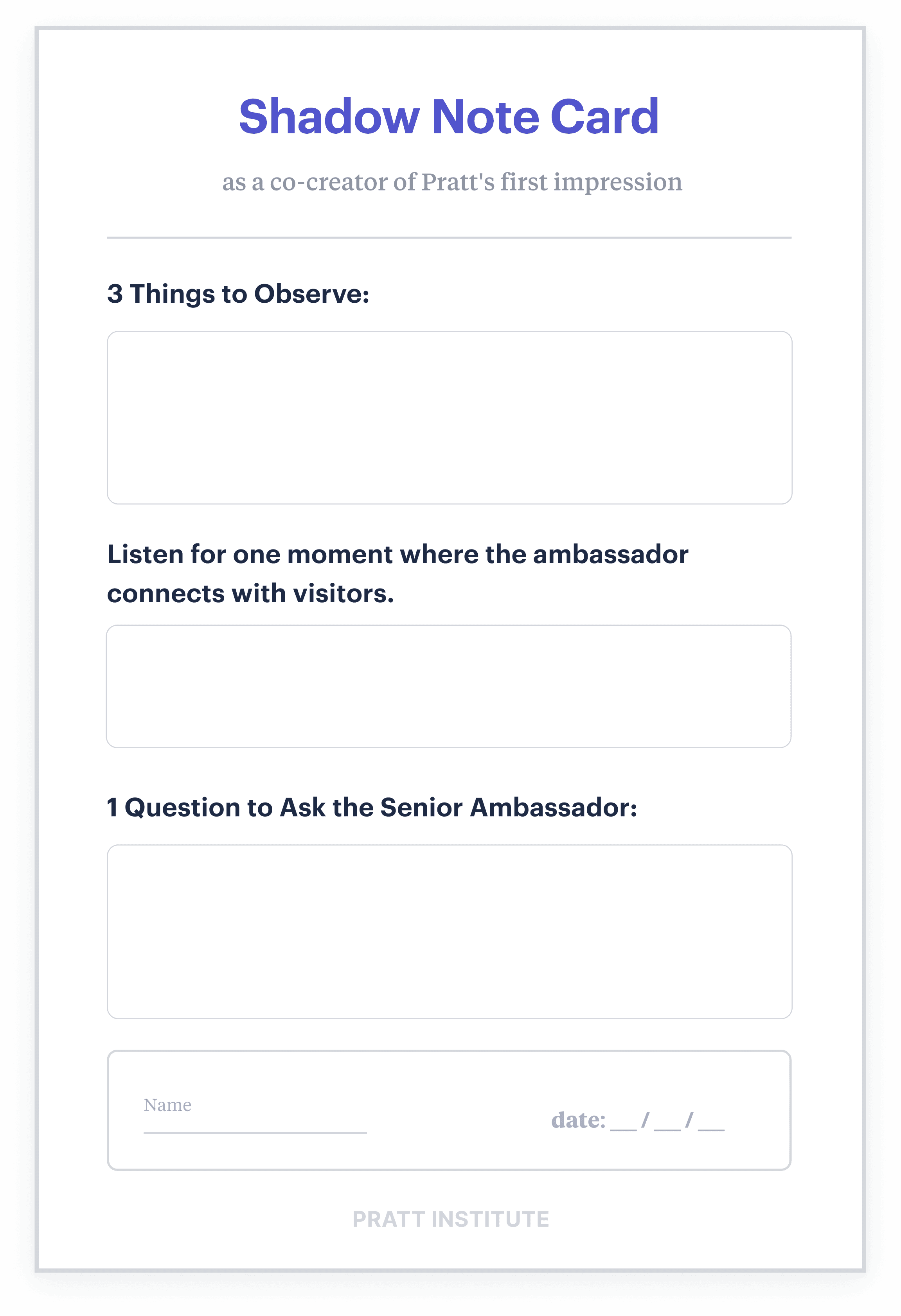
Shadow Note Card
What it is?
This is used during the first two weeks when a new recruit shadows a senior ambassador. It prompts them to note three things to observe, listen for a moment of visitor connection, and write one question to ask the senior ambassador.
Why it matters?
Encourages active observation instead of passive shadowing and helps new ambassadors notice moments of visitor connection.
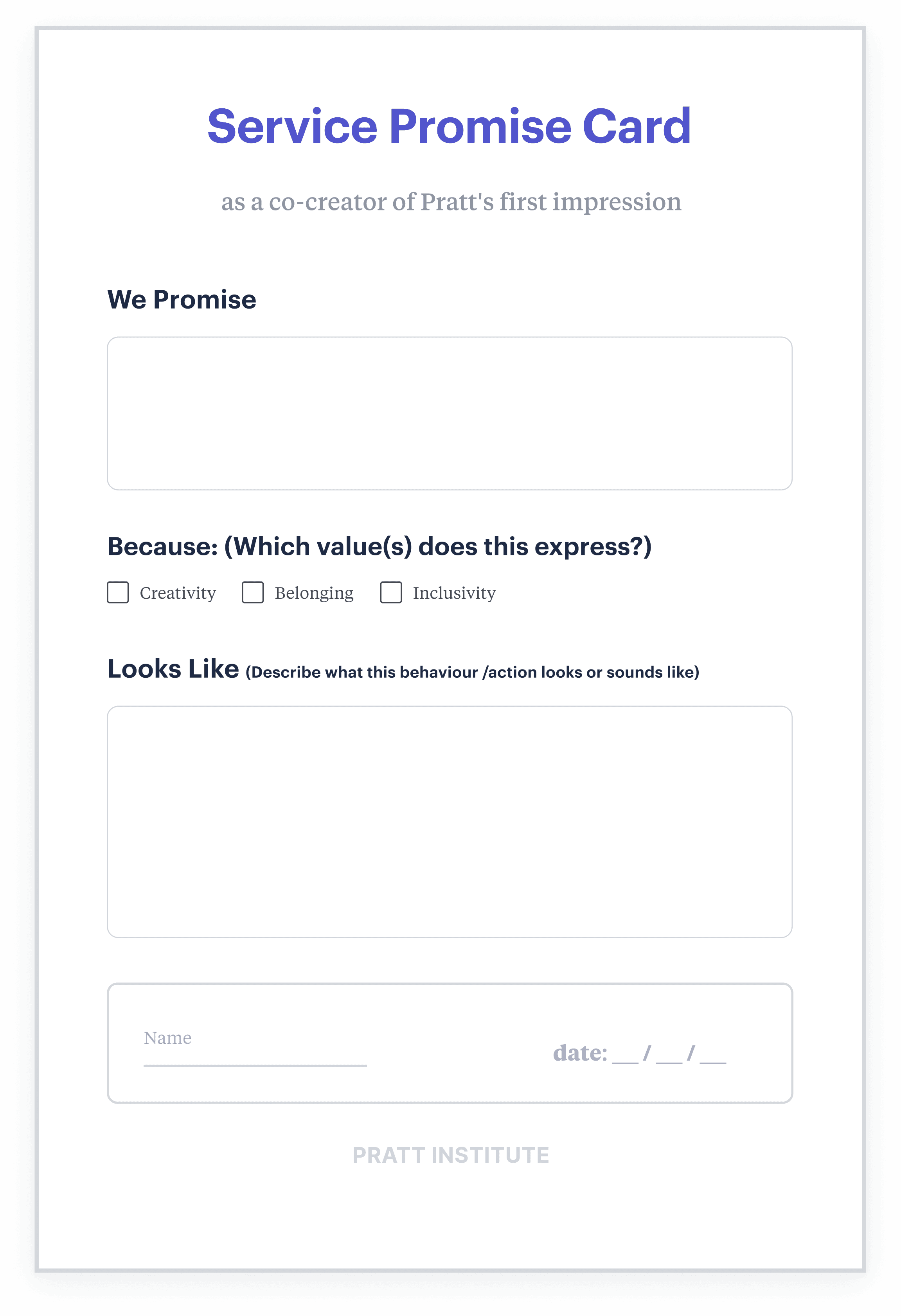
Service Promise Card
What it is?
It's a card where ambassadors write a "We Promise" statement to visitors and then describe how they will keep that promise in real life, focusing on Pratt's values (creativity, belonging, and inclusivity).
Why it matters?
Aligns ambassadors around shared values, creativity, belonging, and inclusivity, so tours feel consistent regardless of who leads them.
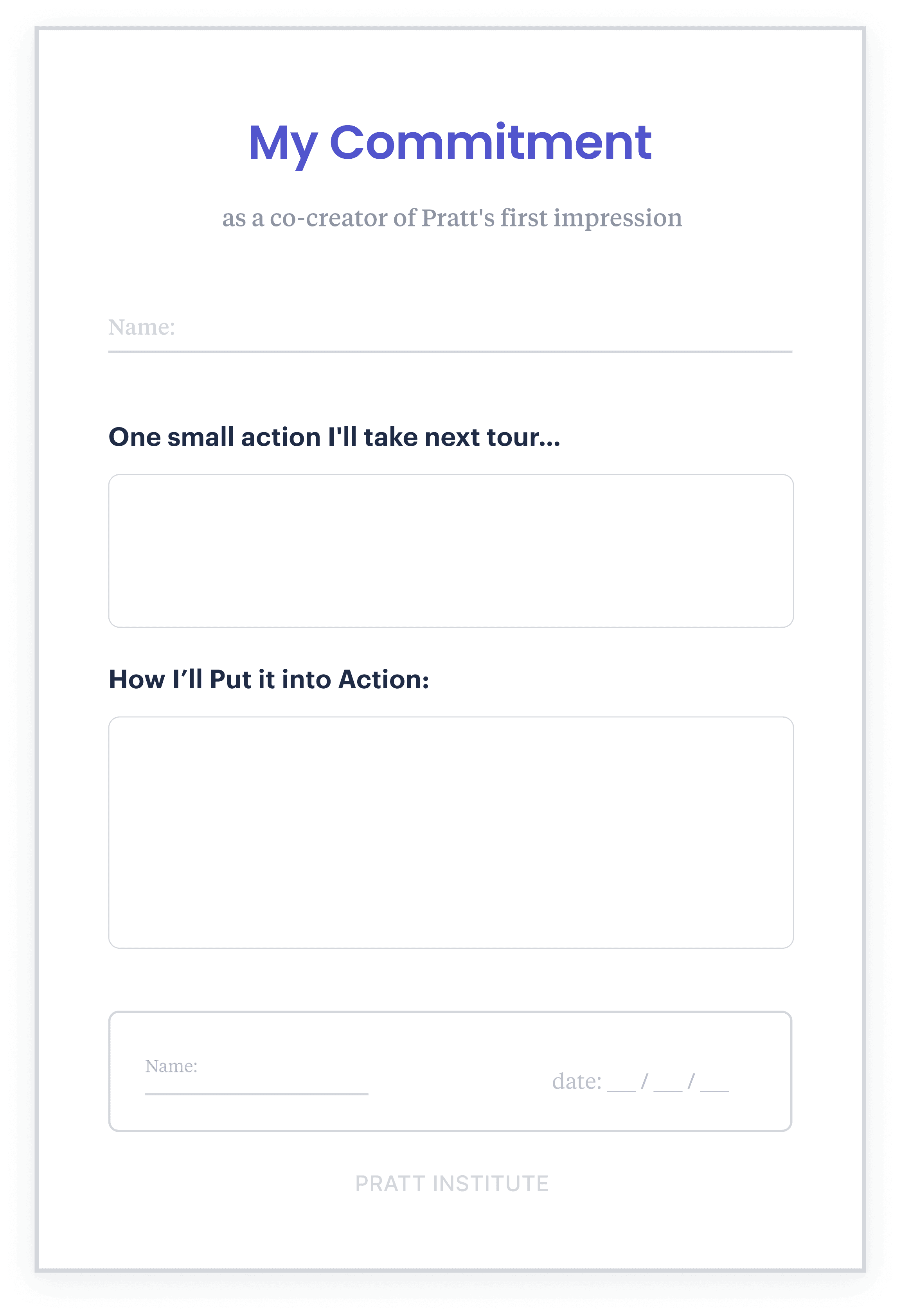
Commitment Card
What it is?
The Commitment Card is a tool used at the end of the first training workshop where new ambassadors focus on making the material immediately useful by identifying one small, specific action they will try on their next tour, along with how they plan to put it into action. This simple process helps new ambassadors bridge the gap between learning theory and practicing behavior.
Why it matters?
Bridges the gap between training and practice by prompting ambassadors to take one small, concrete action on their next tour.
With a shared foundation in place, ambassadors are better prepared when they begin leading tours independently.
Phase 2: Doing – Supporting Consistent Tours in Real Time
Even experienced ambassadors can feel pressure when leading tours. To reduce cognitive load and improve consistency, we introduced lightweight tools ambassadors can reference in the moment.
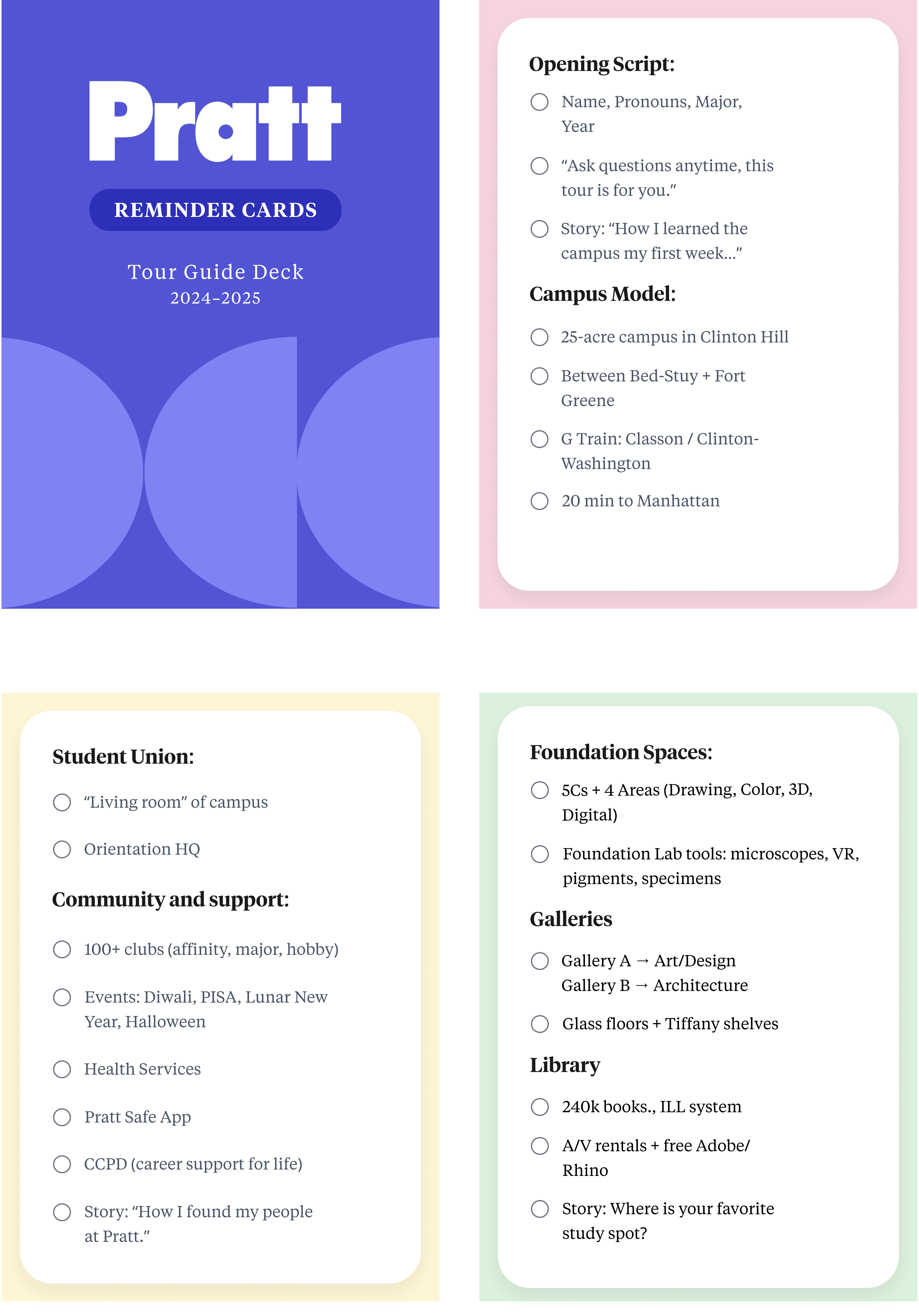
Cue Cards (Print + Mobile)
What it is?
These are Cue Cards (physical or digital) that ambassadors can quickly check during tours to remember key facts and talking points.These Cue Cards give ambassadors quick access to key facts and talking points they can reference while leading tours.
Why it matters?
Provides quick access to key facts, stories, and prompts, reducing stress and ensuring visitors receive accurate, consistent information.
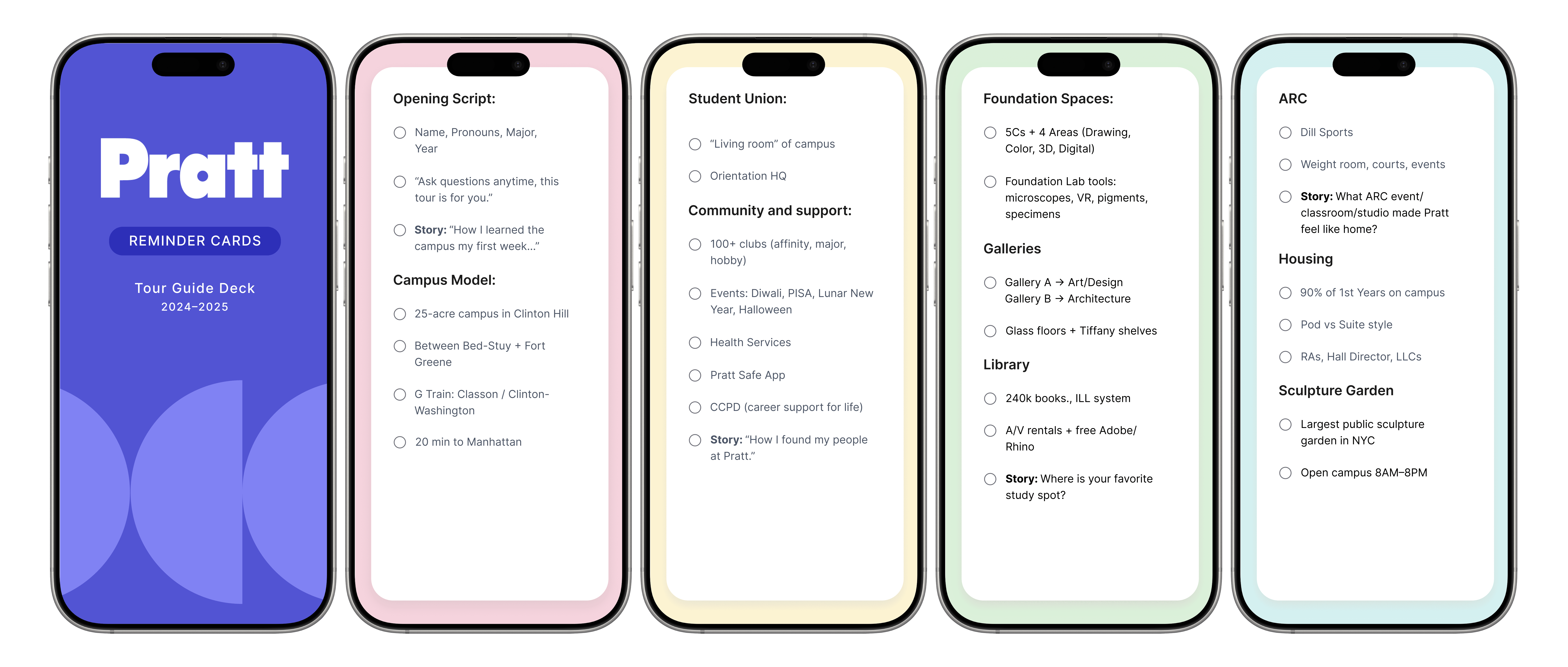
After leading tours independently, ambassadors reflect on what worked, what didn’t, and how to improve future tours.
Phase 3: Reviewing – Reflection as a Team Practice
Instead of waiting until issues escalate, we introduced short, structured reflection moments to help ambassadors process challenges and improve together.
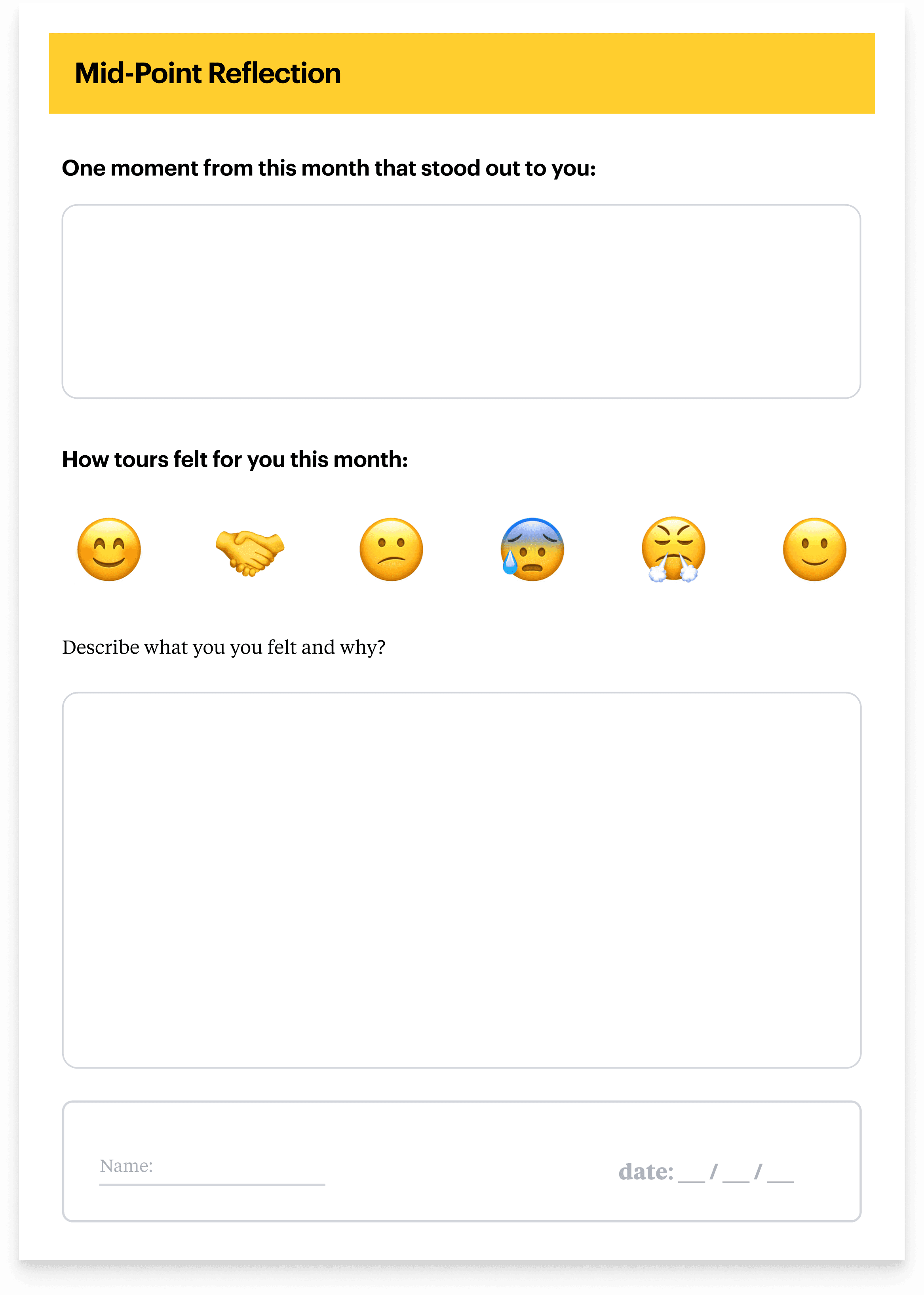
Mid-Point Reflection Sheet
What it is?
A short reflection tool used in the midpoint workshop where ambassadors describe how tours felt that month and note one moment that stood out.
Why it matters?
Creates space for emotional check-ins and surfaces early signs of burnout or frustration.
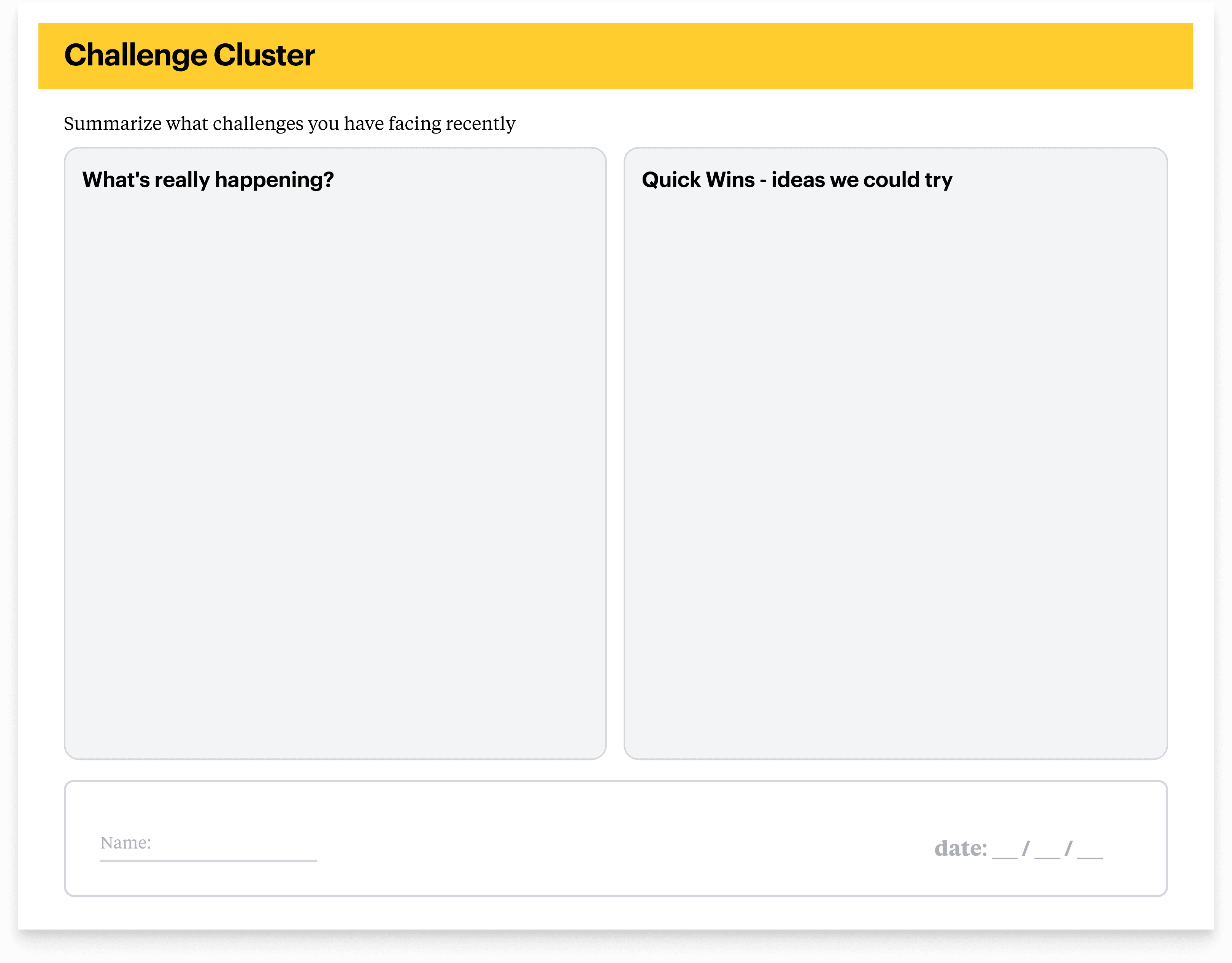
Challenge Cluster Sheet
What it is?
This worksheet helps ambassadors, right after they reflect, to list their tour challenges, discover why those problems are happening, and suggest quick, simple solutions. It was added so the team can better understand issues and make fast improvements.
Why it matters?
Helps ambassadors move from vague frustrations to actionable improvements.
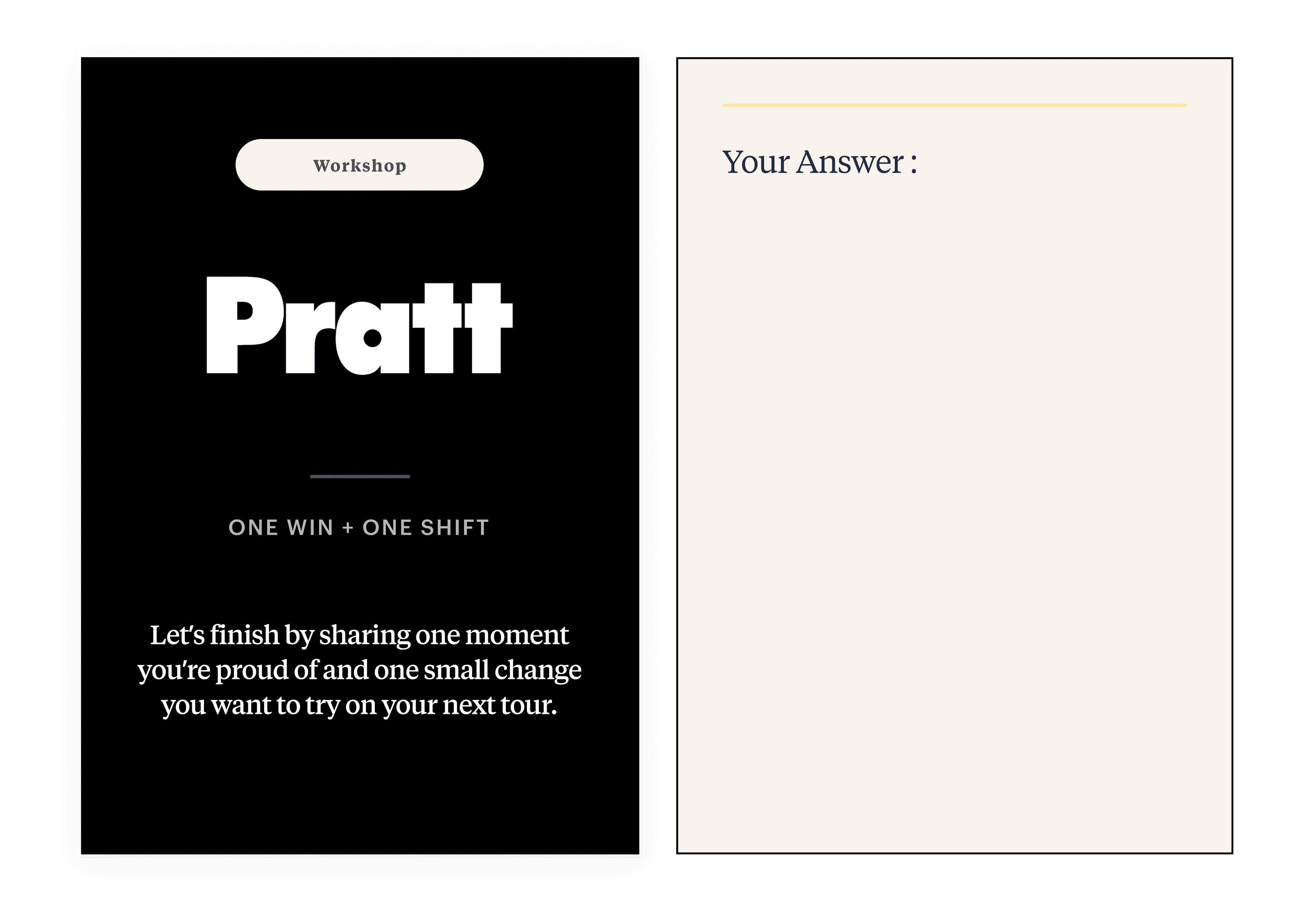
One Win + One Shift Card
What it is?
This card closes the workshop by having ambassadors identify a success they are proud of and commit to a minor adjustment for their next tour.
Why it matters?
Ends reflection on a positive note while reinforcing a culture of growth and experimentation.
Intervention 2 – Updated Visitor Welcome Packet
The welcome packet is the final artifact visitors take home after their campus tour. However, our research revealed that the existing packet did little to support visitors once they left campus. Information was scattered, key details were difficult to find, and there was no clear guidance on what to do next, leaving many visitors unsure how to move forward in their decision-making process.
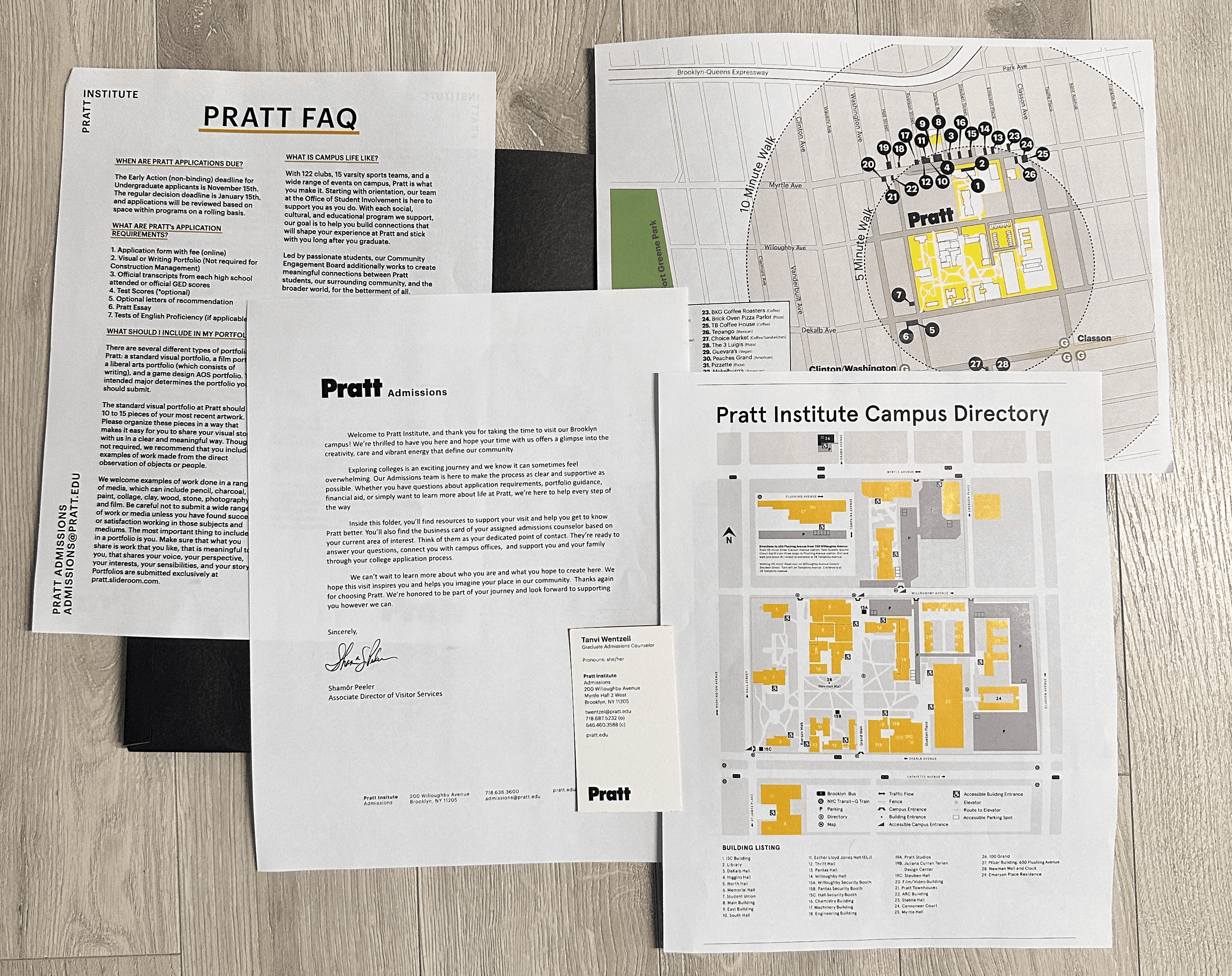
What Visitors Receive Today
The existing packet includes helpful materials, but lacks visual hierarchy, consistency, and clear orientation. Visitors must piece together information on their own, increasing cognitive load after an already information-heavy tour.
Our Design Goal
Based on survey data and co-design insights, our goal was to transform the welcome packet from a static takeaway into an active support tool, one that helps visitors recall key information, access reliable resources, and understand next steps after the tour.
Improve clarity and scannability
Reduce reliance on memory
Extend support beyond the tour
What We Updated
Now show the updated packet and walk through changes one component at a time.
Component 1: Pratt Logo Sticker
What it is?
A Pratt brand logo sticker added to the existing black folder as a small but meaningful brand upgrade.
Why it matters?
t reinforces brand identity, creates a sense of belonging, and serves as a positive reminder of the visit after visitors leave campus.
Component 2: Welcome Pratt One-Pager
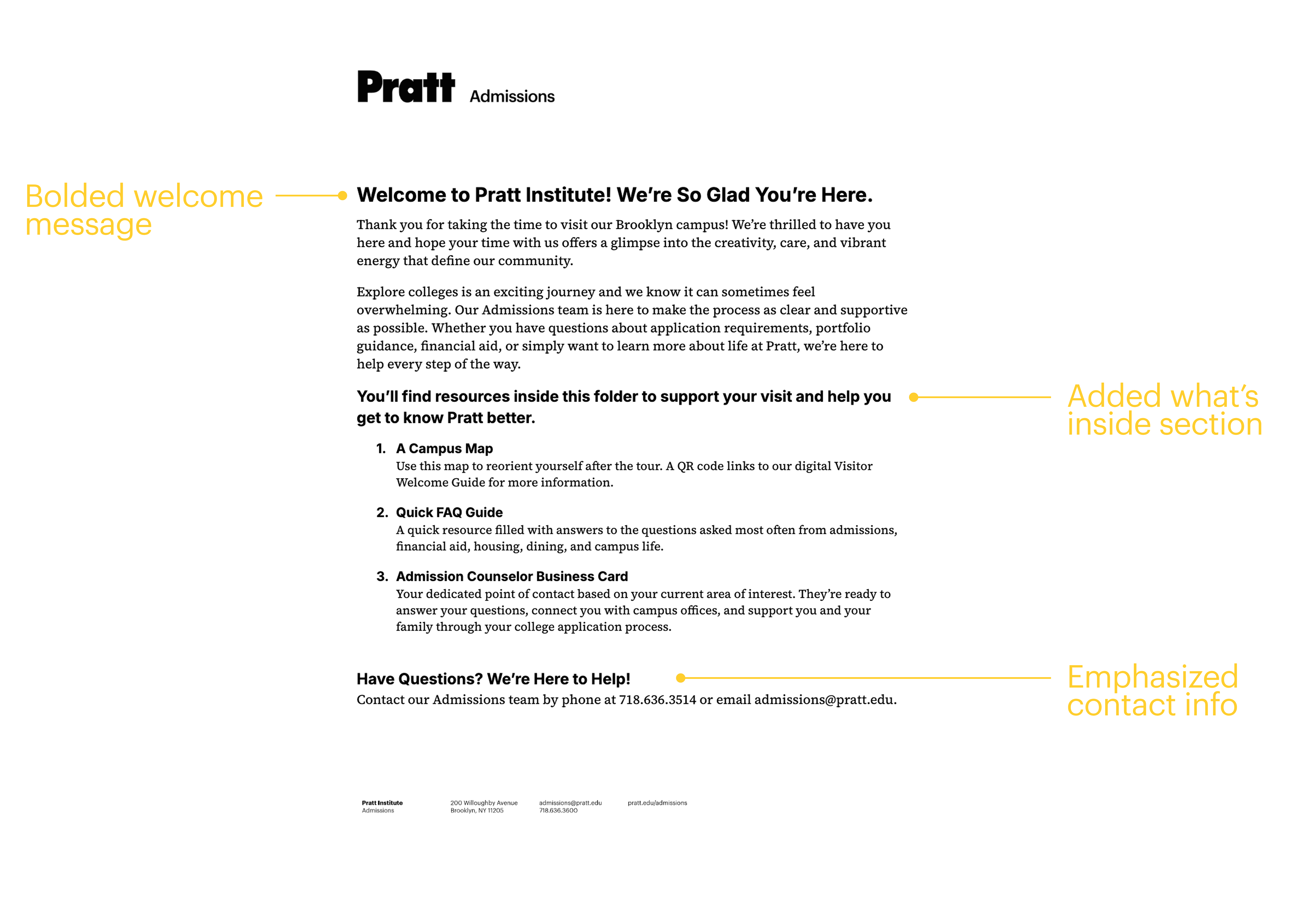
What it is?
A redesigned overview page that introduces what’s inside the packet, highlights key contacts, and outlines clear next steps after the tour.
Why it matters?
It helps visitors quickly understand the purpose of the packet and reduces confusion once they leave campus, especially after an information-heavy visit.
Component 3: Redesigned Campus Map
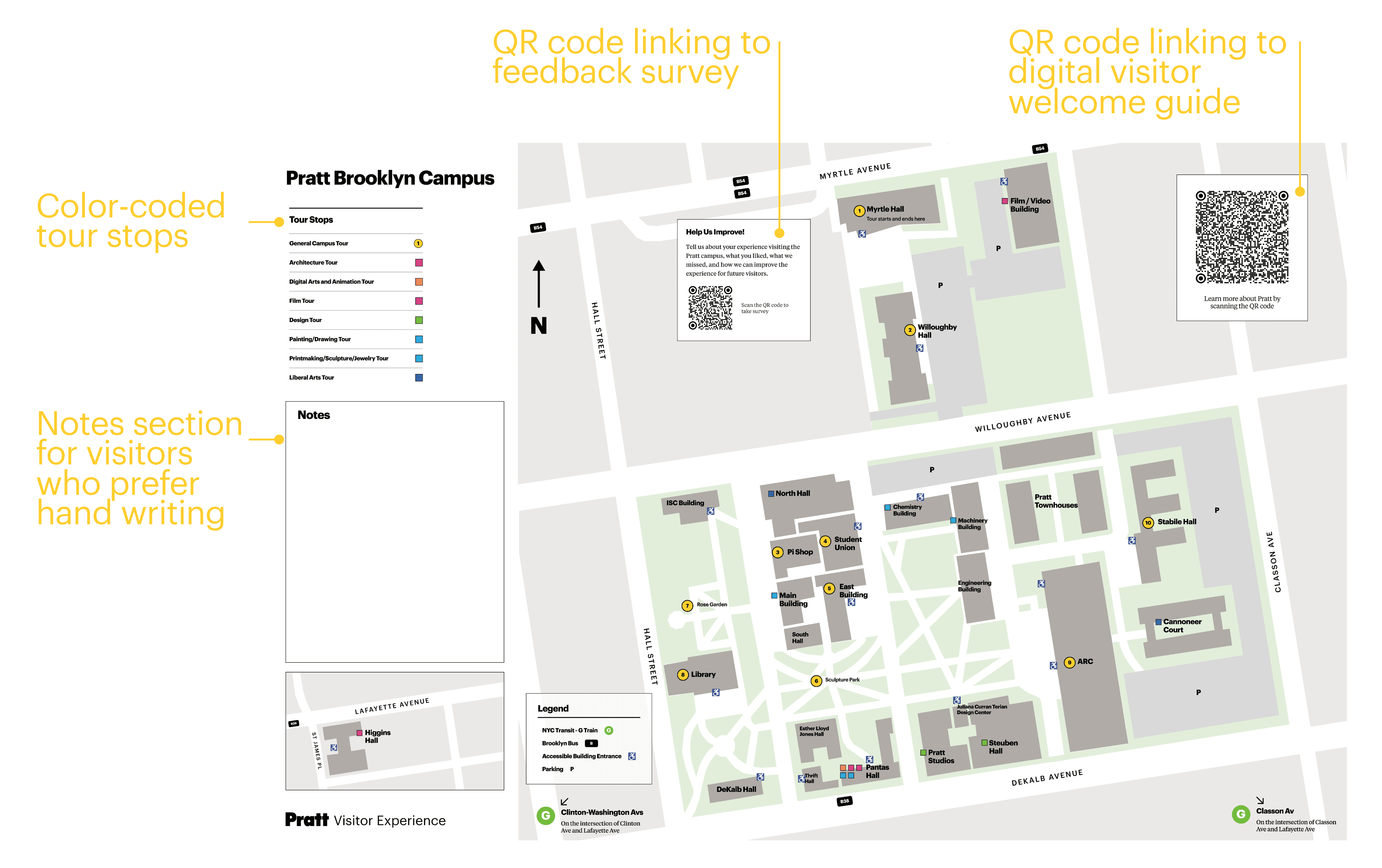
What it is?
A simplified, color-coded campus map with labeled tour stops, a notes section, and QR codes linking to digital resources.
Why it matters?
Clear wayfinding reduces stress during the visit and helps visitors stay oriented both during and after the tour.
Component 3: Digital Visitor Welcome Guide
What it is?
A new webpage added under the Admissions section of Pratt’s website that compiles essential visitor information with clear calls to action linking to official pages.
Why it matters?
It provides an always-available reference visitors can revisit during decision-making, extending support beyond the physical visit.

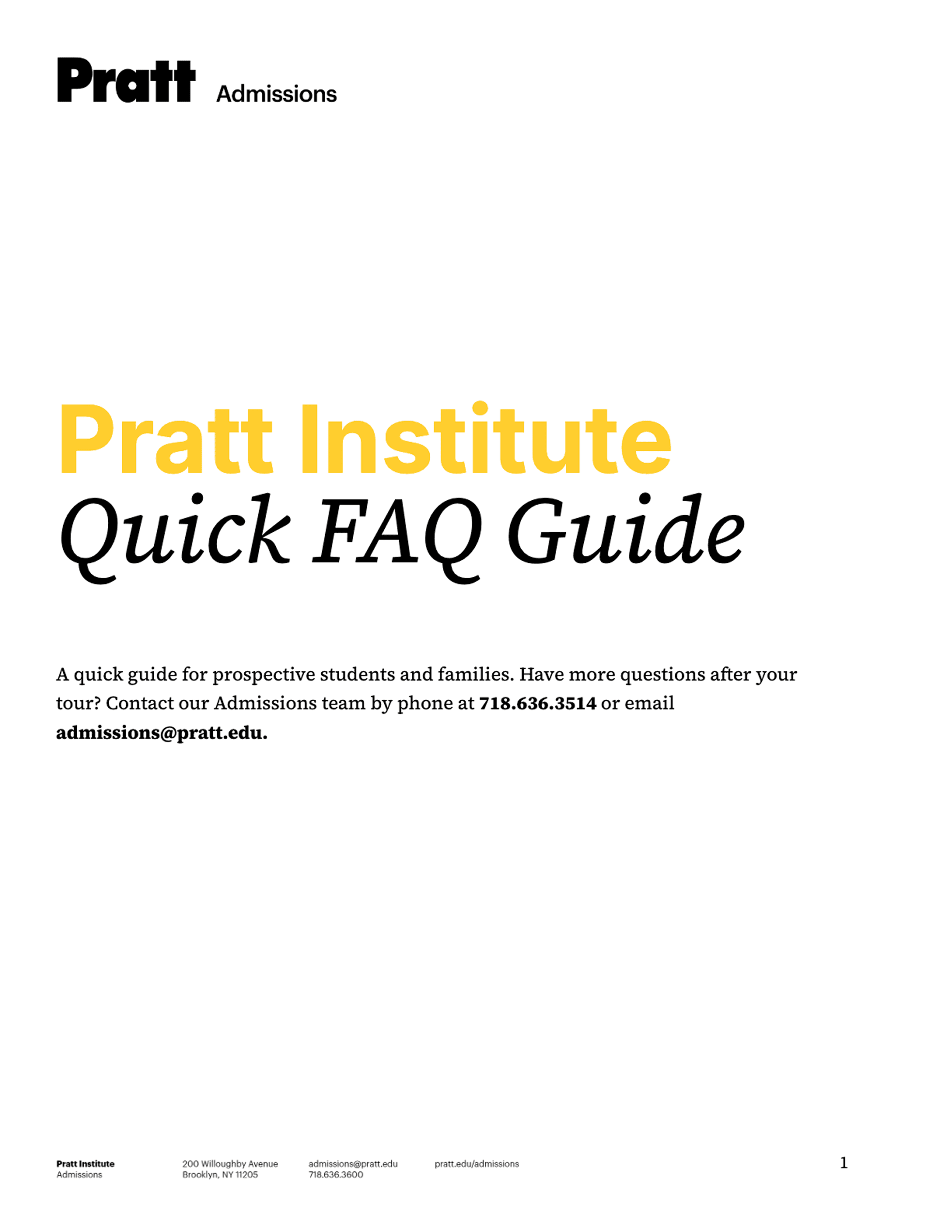
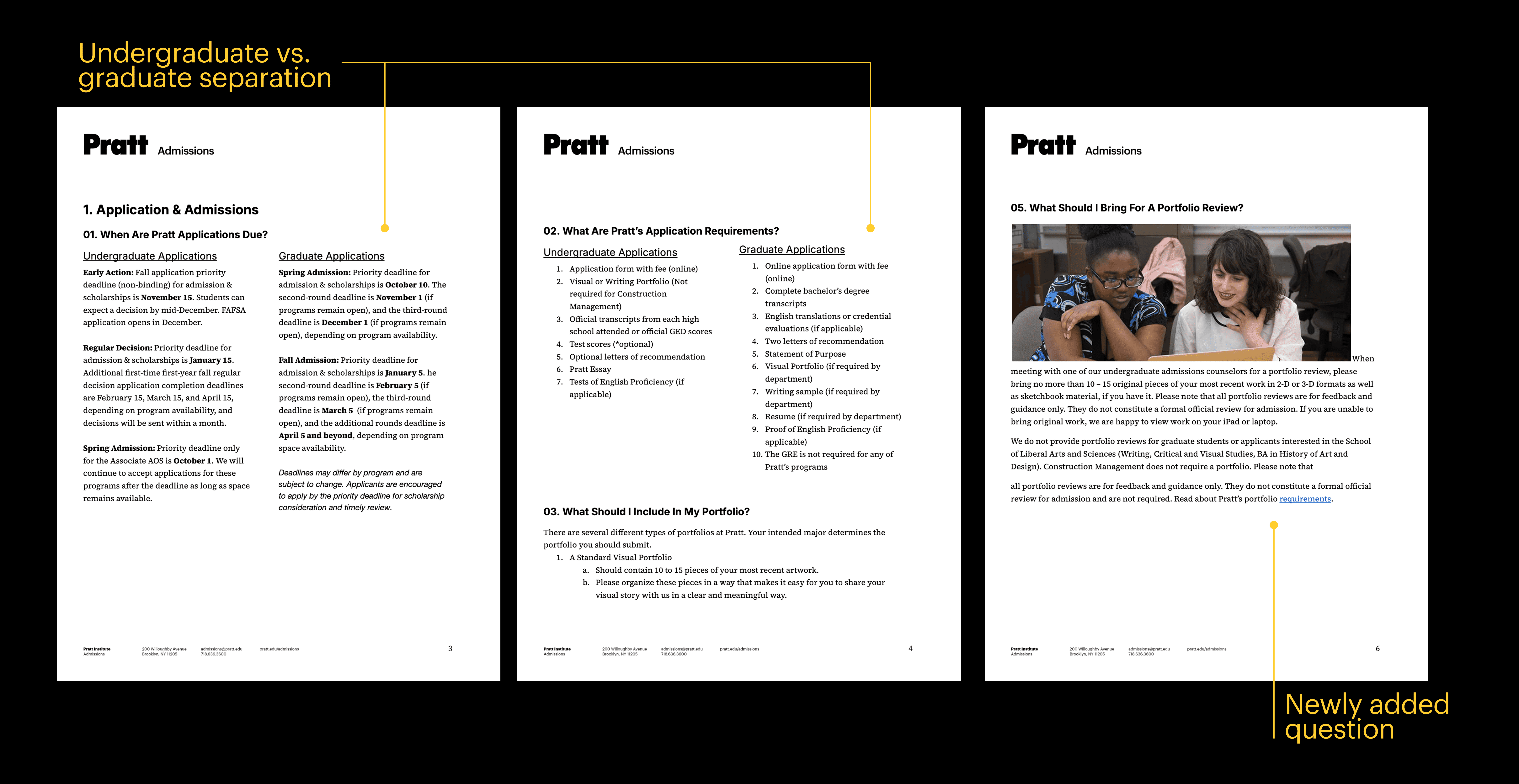
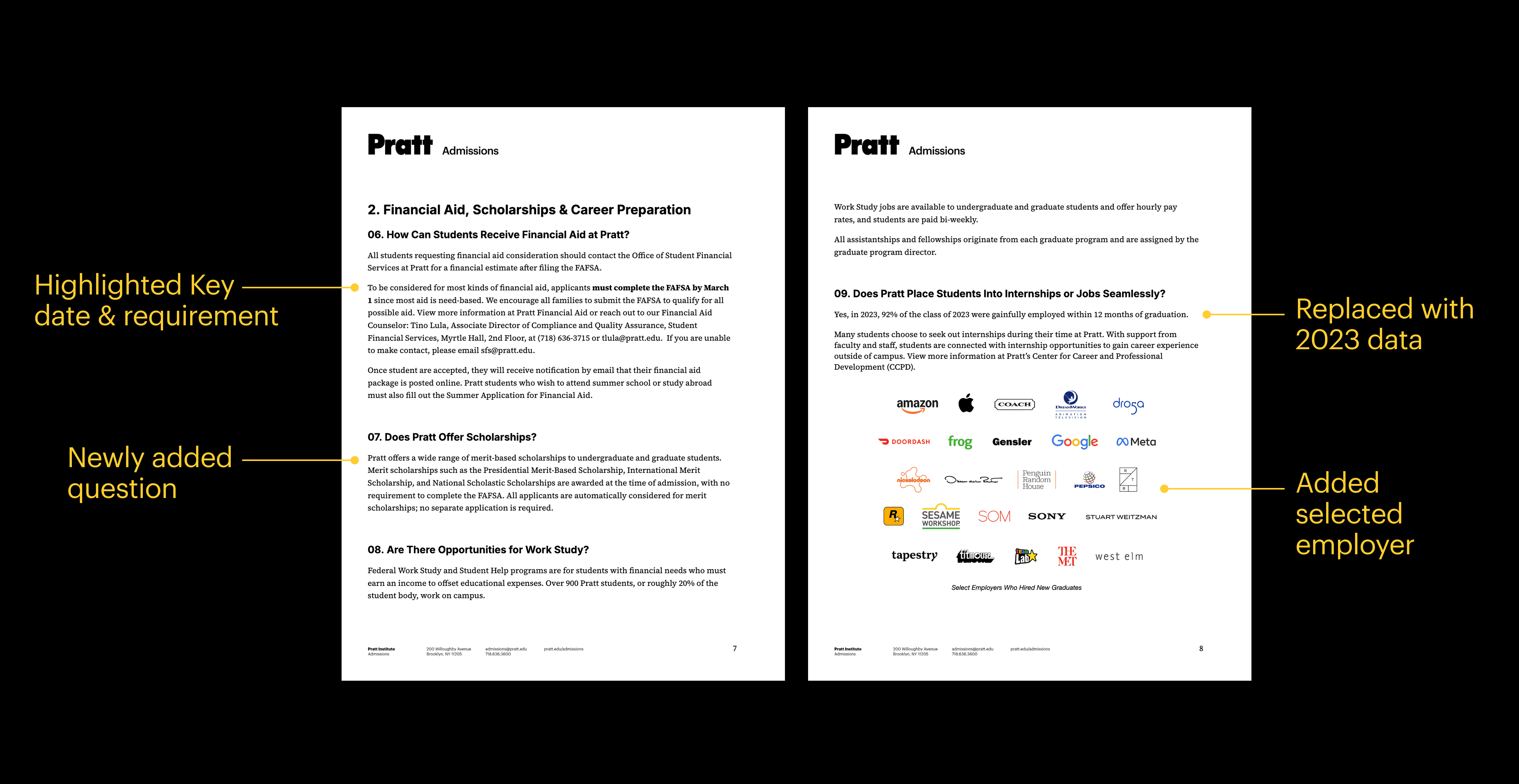
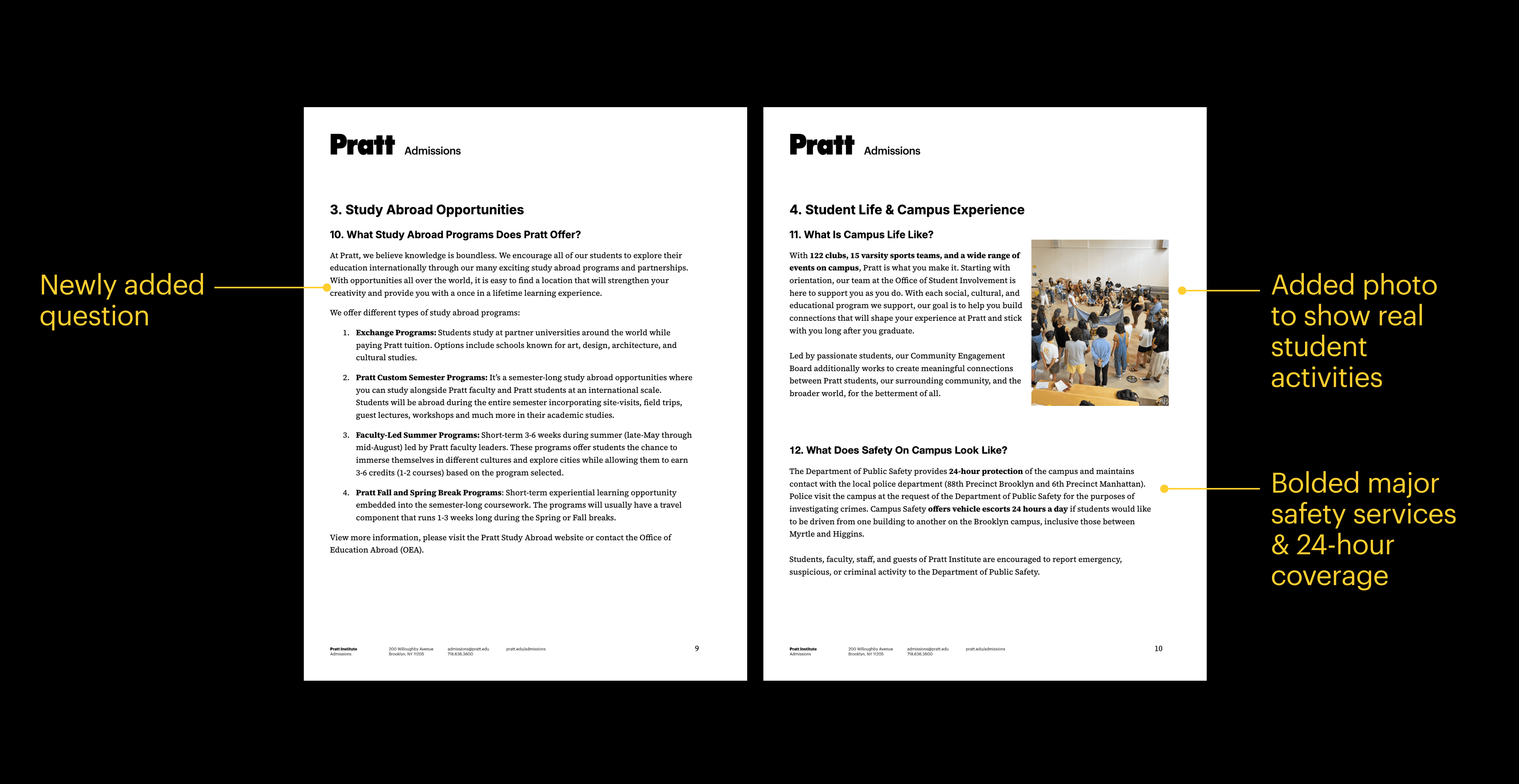
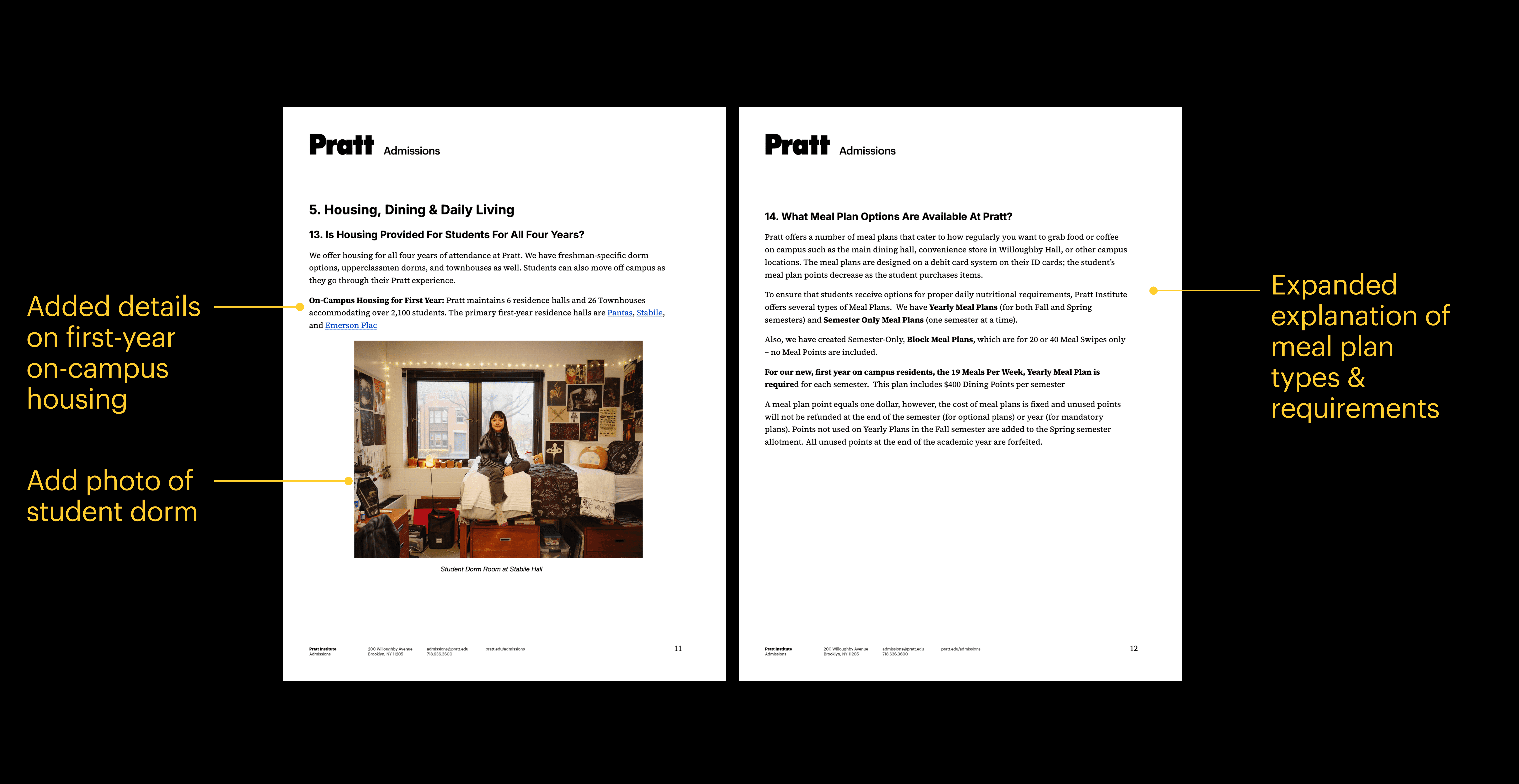
Component 4: Quick FAQ Guide
What it is?
A reorganized FAQ layout that expands on frequently asked questions, clearly separates undergraduate and graduate information, and improves readability.
Why it matters?
It serves as an easy-to-use reference and addresses common post-tour questions proactively, reducing uncertainty and repeated follow-ups to ambassadors and admissions staff.
• FUTURE SUGGESTIONS
Future Opportunities
While these interventions address the most immediate and feasible gaps in the visitor experience, additional opportunities remain to further strengthen the service as a whole. The following suggestions outline potential next steps that extend beyond the scope of this project.
Personalized Postcards from Ambassadors
A quick handwritten or digital note sent after the tour reinforces connection and makes visitors feel personally welcomed by Pratt.
Clear Wayfinding Support at Arrival
“Human signposts” and clearer directional cues reduce confusion at security and create a more welcoming first impression. This transforms a stressful checkpoint into a moment of hospitality.
Redesign the Post-Tour Survey
Current surveys rely on vague questions like “Did you enjoy the tour?” We recommend clearer, behavior-based questions sent immediately after the visit to generate actionable insights for ambassador training.
Strengthen Pre- & Post-Visit Communication
Visitors often arrive confused due to unclear logistics. Adding an “Add to Calendar” CTA, essential maps and prep notes, and a brief post-visit “What’s Next” message creates a smoother, more supportive journey.
• CLIENT IMPACT
Bringing the Results Back to the Client
We presented our findings and proposed interventions to the a group of audience, including the dean of School of Information, staffs from OEA, staffs from ORSP, and Director of Admissions. The client responded positively, highlighting the practicality and relevance of the solutions, especially the updated FAQ content.
"This is great work. We especially love the FAQ update. We do see a lot of questions about portfolio reviews and application requirements. These updates could really help us improve the service."
— Tricia Hughes, Direction of Admissions
This feedback reinforced that our recommendations addressed real, recurring challenges faced by both visitors and staff, and demonstrated the value of grounding service improvements in research and stakeholder collaboration.
• PROJECT TAKEAWAYS
What I Learned?
Designing within institutional constraints requires strategic thinking
Designing for an institution means working within real constraints, policies, budgets, implementation timelines, feasibility, and multiple layers of approval. This project pushed me to think beyond ideal solutions and focus on what could realistically be implemented and sustained within an organizational context.
Co-design reveals insights that other methods cannot
The co-design workshops proved to be a powerful method for uncovering insights that did not surface through surveys or service safari alone. Designing with student ambassadors ensured that our solutions were grounded in lived experience and aligned with how the service is actually delivered day to day.
Service design goes far beyond mapping the big picture
Before this class, I understood service design primarily as mapping the end-to-end flow of a service. Through this course, I realized that this view was only surface-level. Service design also requires navigating complex stakeholder relationships, understanding value exchange, managing competing needs, and making trade-offs across people, systems, and institutions.